Indian Polity & Governance
Supreme Court on Forest Land Diversion Compliance:
Context: The Supreme Court reasserted that forest land diversion in India must adhere to statutory procedures, reinforcing that environmental protection cannot be subordinated to expediency.
-
- Statutory framework under Forest (Conservation) Act: The Forest (Conservation) Act mandates prior approval of the Union Government before any forest land can be diverted for non-forest use, a procedure that cannot be bypassed.
- Difference Between Forest and Environmental Clearances: Forest clearance (under the Forest Conservation Act) is a separate statutory requirement from environmental clearance (under the Environment Impact Assessment Notification). Both must be obtained independently.
- Compensatory afforestation limits: The Court clarified that compensatory afforestation (CA) cannot be treated as equivalent to natural forest and does not justify diversion without rigorous assessment.
- Role of Statutory Bodies: Statutory bodies like Forest Advisory Committee (FAC) must evaluate diversion proposals based on ecological cost, forest value, and public use criterion.
- Public Interest vs Ecological Cost: The Court emphasised that economic gains must be balanced with ecological cost, thereby strengthening the precautionary principle.
- Judicial Oversight: Delay or irregular compliance with clearance procedures invites judicial scrutiny, especially where irreversible ecological loss is evident.
- Impact on State Governments: States cannot bypass central approval by issuing secondary permits; Forest diversion remains a matter of national environmental significance.
- Integration with Biodiversity Goals: The ruling aligns India’s internal jurisprudence with global environmental governance norms that prioritise ecological sustainability.
(IE)
AI Use in Governance and Data Privacy Mandates:
Context: The Government reiterated that all use of AI in governance must comply with data protection norms, ethics standards and privacy principles.
-
- Data Minimisation: AI systems must collect only data strictly necessary for the task, reducing privacy invasion risk.
- Consent-based Data Usage: Personal data used in automation or AI analysis must have explicit consent from individuals.
- Independent Auditing: AI systems deployed in public services must be audited by independent bodies to detect bias, unfair outcomes, algorithmic opacity, or privacy lapses.
- No Algorithmic Opacity: AI decision logic in critical services (health, justice, welfare) cannot be hidden; explainability is mandated.
- Human Responsibility: A human officer must remain accountable for decisions supported by AI, guarding against unchecked algorithmic decisions.
- Security Safeguards: Data used by AI must be protected with robust cybersecurity measures to prevent breaches and misuse.
- Sector-wide Application: These principles apply across sectors, from digital health solutions to automated grievance redress.
- Policy Integration: Ethical AI principles will be incorporated in broader data protection and digital governance strategies.
(PIB)
International Relations
India-Japan Strategic & Economic Dialogue:
Context: India and Japan held high-level strategic dialogue focusing on economic security, strategic supply chains, and Indo-Pacific cooperation.
-
- Supply chain resilience: Both countries discussed building diversified, de-risked supply chains to reduce over-dependence on single sources in key sectors like electronics and pharmaceuticals.
- Semiconductor value chain cooperation: India and Japan explored collaboration in semiconductor manufacturing and design, leveraging incentives and investments from both governments.
- Infrastructure financing: Japan reiterated its commitment to financing sustainable infrastructure projects in India, reinforcing India as a key partner under the Asia-Africa Growth Corridor.
- Indo-Pacific convergence: The dialogue underscored shared visions for a free, open, inclusive and rules-based Indo-Pacific, reflecting geostrategic alignment.
- Maritime security cooperation: Naval exercises, information sharing and port cooperation were highlighted as areas of deepening defence ties.
- Economic Security as a Strategic Objective: Beyond trade, economic security was treated as a strategic priority, with emphasis on technology and critical minerals.
- Private sector linkages: Business delegations from both countries participated, exploring joint ventures and technology partnerships.
- Multilateral cooperation: On shared priorities in global forums such as G20 and Quad, indicating coordinated diplomacy.

(TH)
Geography, Mapping, Ecology & Environment and DM
Urban Heat Island (UHI) Effect in Indian Cities:
Context: Ahead of summer, studies and municipal bodies flagged increasing UHI intensity in India’s major cities, prompting calls for planning reforms.
-
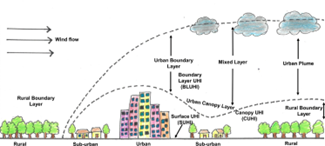
- Defining UHI Effect: Urban Heat Island refers to a city’s ambient temperature being higher than surrounding rural areas due to built surfaces absorbing and re-radiating heat.
- Role of Impervious Surfaces: Roads, rooftops and pavements trap heat because they lack natural cooling provided by soil and vegetation.
- Night-time Heat Stress: UHI disproportionately affects night temperatures, limiting relief after sunset and increasing heat stress for residents.
- Public health implications: Heat exposure increases risks of heat exhaustion, dehydration, cardiovascular stress and mortality, especially for the elderly and outdoor workers.
- Urban planning deficiencies: Poor planning, lack of green spaces, encroachment on water bodies and inadequate cooling infrastructure exacerbate UHI.
- Climate change linkages: Global warming amplifies UHI intensity, making cities hotter than rural surroundings even with moderate external temperatures.
- Mitigation strategies: Actions include tree plantations, cool roofs, reflective pavements, water bodies preservation, and enhanced public transport planning.
- Governance response: Municipalities are now integrating heat action plans, evaluation tools, and alert systems to protect vulnerable populations.
(TH)
Important data/facts
Geography & Environment
India’s Renewable Energy Capacity Review:
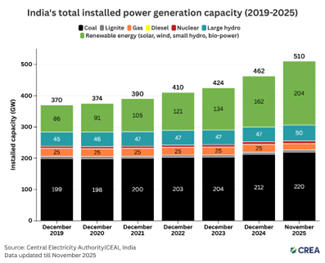
Context: India reviewed progress toward ambitious renewable energy capacity targets, as part of its climate commitments and energy transition strategy.
-
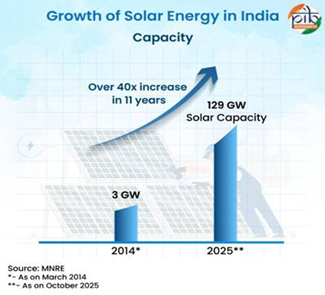
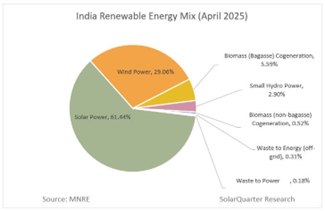
- Solar energy dominance: Solar power continues to lead capacity additions due to declining technology costs, large-scale parks, and supportive policies.
-
- Wind power progress: Wind energy’s growth remains uneven, with state-by-state variation depending on land availability, transmission infrastructure and investment climate.
- Grid integration challenges: Intermittency of renewables poses a challenge for grid stability, requiring enhanced ancillary services, forecasting and balancing mechanisms.
- Battery storage constraints: The lack of large-scale, affordable storage facilities limits renewable energy absorption, especially during peak generation.
- Policy support continuity: Government frameworks like Renewable Purchase Obligations (RPOs) and auctions drive capacity additions.
- Financing bottlenecks: High capital costs and risk perceptions among financiers slow investment, especially in emerging segments like green hydrogen infrastructure.
- Regional disparities: States with better transmission networks and fiscal incentives outperform others in capacity additions.
- Net-zero commitment linkage: Progress in renewables is aligned with India’s commitment of net zero by 2070, adding credibility to climate pledges.
(TH)
Spread the Word
The post Prelims Mantra – (17/02/2026) appeared first on Lukmaan IAS.