BACTRIAN CAMELS, ZANSKAR PONIES & RAPTORS AT REPUBLIC DAY PARADE
WHY THE RVC CONTINGENT IS SPECIAL THIS YEAR?
- At the annual Republic Day Parade, the Remount and Veterinary Corps (RVC) of the Indian Army is usually represented only by its Army dog squad.
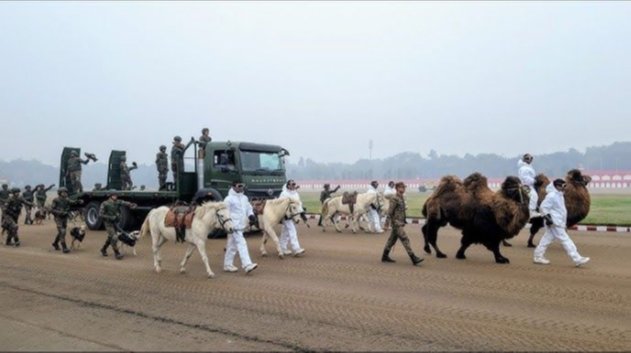
- In 2026, for the first time, the RVC will present a specially curated animal contingent that includes Bactrian camels, Zanskar ponies, Army dogs, and raptors.
- This marks a historic moment in the 247-year history of the Corps.
- Adding to the significance, the contingent will be led by a woman officer, Captain Harshita Raghav, who is among the first women inducted into the RVC in 2023.
WHAT IS REMOUNT & VETERINARY CORPS?
- The Remount and Veterinary Corps (RVC) is a specialised corps of the Indian Army.
- It is responsible for the:
- Breeding, rearing, and training of Army animals
- Veterinary care and health management of these animals
- Animals under the RVC include:
-
- Horses
- Mules
- Army dogs
- Other specialised animals used for logistics and operations
- The RVC ensures that Army animals remain combat-ready and operationally fit, especially in:
- High-altitude regions
- Difficult and inaccessible terrain
- The Corps also supports counter-terrorism operations, reconnaissance, and disaster response.
HISTORICAL EVOLUTION OF RVC
- The origins of the RVC trace back to 1779, with the establishment of the Stud Department in Bengal, making it one of the oldest branches of the Indian Army.
- Key milestones in its evolution include:
- Renamed as the Army Veterinary Corps (India) in 1920
- Became the Indian Remount and Veterinary Corps in 1950
- Formally designated as the Remount and Veterinary Corps (RVC) in 1960
- The Corps’ motto is “Pashu Seva Asmakam Dharma”, meaning “Service to animals is our duty.”
ROLE OF RVC IN INDIA’S MILITARY HISTORY
- The RVC has played a critical role in all major conflicts, both before and after Independence.
- It served with distinction during:
- The First World War
- The Second World War
- Post-Independence military operations and wars
- In recognition of its meritorious service, the Corps was awarded the President’s Flag in 1989.
- The Corps headquarters is located in Meerut, Uttar Pradesh.
OPERATIONAL IMPORTANCE OF ARMY ANIMALS
- Despite modern technology, Army animals continue to play an irreplaceable role.
Mules
- Mules remain one of the most reliable and cost-effective means of transporting supplies.
- They are essential in:
- High-altitude areas
- Narrow mountain paths
- Regions where vehicles or helicopters cannot operate
Army dogs
- Army dogs are trained for specialised tasks such as:
- Explosive and mine detection
- Tracking terrorists
- Guarding military installations
- Search-and-rescue missions during disasters and avalanches
- Direct combat roles
NON COMBAT ROLES OF RVC
- Apart from battlefield duties, the RVC contributes to:
- Military diplomacy, by providing trained animals to friendly foreign countries
- National Cadet Corps (NCC) programmes through horse-riding training
- Veterinary assistance in remote and border areas
- Participation in United Nations peacekeeping missions
COMPOSITION OF THE ANIMAL CONTINGENT IN REPUBLIC DAY PARADE 2026
- The RVC contingent at the 2026 Republic Day Parade has been designed to highlight the Corps as a force multiplier in extreme terrains.
- The contingent symbolises the deep bond between soldiers and animals in defending the nation.
BACTRIAN CAMELS: LEADING THE CONTINGENT
- Bactrian camels will lead the RVC contingent at the parade.
- These camels have been inducted by the Army for transport duties in Ladakh’s cold deserts.
- Key characteristics:
- Adapted to extreme cold and altitudes above 15,000 feet
- Can carry loads of up to 250 kilograms
- Capable of negotiating:
- Steep gradients
- Sandy and rocky terrain
- Operational role:
- Logistics support
- Mounted patrolling along the Line of Actual Control (LAC)

ZANSKAR PONIES: INDIGENOUS HIGH ALTITUDE WARRIOR
- The contingent will be followed by Zanskar ponies, an indigenous breed from Ladakh.
- These ponies are known for:
- Exceptional endurance at high altitudes
- Ability to function in sub-zero temperatures
- Despite their small size, they can:
- Carry 40–60 kilograms
- Travel long distances in rugged terrain
- They are deployed in:
- High Himalayan regions
- Forward posts
- Siachen Glacier area
ARMY DOGS & RAPTORS
- Army dogs, the most familiar RVC participants, will march at the rear of the contingent.
- Between 2023 and 2025, the RVC expanded the use of indigenous Indian dog breeds, including:
- Mudhol
- Rampur Hound
- Chippiparai
- Kombai
- Rajapalayam
- The Mudhol Hound became the first Indian breed formally inducted into the RVC in 2016.
- The contingent will also feature four raptors, highlighting specialised animal capabilities within the Army.
INDUCTION OF OFFICERS INTO THE RVC
- Officers are inducted into the RVC as Short Service Commission (SSC) Officers.
- Eligibility requirements include:
- A Bachelor of Veterinary Science and Animal Husbandry (BVSc & AH) degree
- Completion of a compulsory internship
- Age between 21 and 32 years
- Selection process involves:
- Shortlisting based on academic marks
- Services Selection Board (SSB) interview
- Medical examination
- Selected candidates undergo training at Meerut and are commissioned as Captains.
- The first batch of women officers was inducted in 2023, with four women officers joining the Corps.
- Captain Harshita Raghav, leading the 2026 parade, belongs to this historic batch.
ACTIVE PARTICIPATION OF THE RVC IN OPERATIONS
- The RVC has been actively involved in several operations, including:
- Deployment in Sri Lanka as part of the Indian Peace Keeping Force
- Support operations during the Kargil conflict, ensuring animal transport to remote posts
- Disaster relief during:
- Wayanad floods (August 2024)
- Himachal Pradesh and Uttarakhand floods
SACRIFICE OF THE SILENT WARRIORS
- Many Army animals have made the ultimate sacrifice in the line of duty.
- In 2024, Kent, a six-year-old Labrador, was killed while shielding her handler during a terrorist encounter.
- In another incident, Phantom, a K-9 dog of 9 Para SF, was killed in terrorist gunfire in Akhnoor, Jammu and Kashmir.
- Mansi and Axel are other canine martyrs from the Corps.
- Dogs such as Phantom and Kent have been awarded gallantry honours for their bravery and sacrifice.
Note: Connect with Vajirao & Reddy Institute to keep yourself updated with latest UPSC Current Affairs in English.
Note: We upload Current Affairs Except Sunday.
The post BACTRIAN CAMELS, ZANSKAR PONIES & RAPTORS AT REPUBLIC DAY PARADE appeared first on Vajirao IAS.