BHARAT NCAP 2.0
The Ministry of Road Transport & Highways has released a detailed draft of BHARAT NCAP 2.0.
What is BHARAT NCAP?
It is India’s indigenously designed crash test rating program. It is inspired from Global NCAP.
BHARAT NCAP 2.0 is the advanced version of BHARAT NCAP released in 2023. It us expected to be implemented in 2027.
ABOUT BHARAT NCAP
The Ministry of Road Transport and Highways has rolled out an indigenous star rating system for crash testing cars under which vehicles will be assigned between one to five stars indicating their safety in a collision.
Called the Bharat New Car Assessment Programme (NCAP), the rating system will be voluntary and will come into effect from October 1, 2023.
Though Bharat NCAP is voluntary, in certain cases cars maybe subjected to a crash test such as for a base model of a popular variant (minimum clocked sale of 30,000 units), or when the Ministry of Road Transport and Highway recommends.
WHAT IS BHARAT NCAP?
Under the Bharat NCAP, cars voluntarily nominated by automobile manufacturers will be crash tested as per protocols laid down in the soon to be published Automotive Industry Standard 197.
TO WHICH CARS IS THE PROGRAM APPLICABLE?
The programme is applicable to passenger vehicles with not more than eight seats in addition to the driver’s seat with gross vehicle weight not exceeding 3,500 kgs.
Only the base model of a particular variant will be tested.
RATINGS & PARAMETERS
Cars will be assigned a rating between one star to five stars after being evaluated on three parameters —
- adult occupant protection,
- child occupant protection and
- safety assist technologies present in the car.
OBJECTIVE OF BHARAT NCAP
The objective of the programme is to help consumers make an informed decision before purchasing a car, thereby spurring demand for safer cars.
- India sees nearly 1.5 lakh road fatalities in a year, accounting for 10% of deaths due to road crashes globally with only 1% of the world’s vehicles.
- According to a World Bank study, road crashes are estimated to cost the Indian economy between 5 to 7% of GDP a year.
EVOLUTION OF BHARAT NCAP
The testing protocols adopted by the Bharat NCAP are modelled on the Global NCAP, which is a project of the U.K. based NGO, Towards Zero Foundation.
It serves as a platform for co operation among new car assessment programmes worldwide, including countries such as the U.S. which has the world’s oldest crash testing regime since 1978.
The NGO launched a Safer Cars for India campaign in 2014 when it released the country’s first independent crash tests covering 5 car models. All, except 1 failed the tests and scored zero rating.
GUIDELINES IN 2.0
The new framework moves beyond the current focus on just adult and child occupant protection by introducing a holistic 100-point scoring system across five pillars:
- Crash Protection (55% weightage): Evaluates how well a car protects occupants during a collision.
- Vulnerable Road User Protection (20% weightage): A new addition focusing on pedestrian and two-wheeler safety.
- Safe Driving (10% weightage): Assesses features that help the driver avoid errors.
- Accident Avoidance (10% weightage): Focuses on active systems that prevent accidents autonomously.
- Post-Crash Safety (5% weightage): Evaluates post-crash mitigation of hazards and ease of rescue.
EXPANDED CRASH TESTS
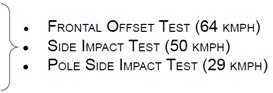
The number of mandatory crash tests will expand from two to five to cover a wider range of real-world scenarios:
- 64 km/h offset frontal impact
- 50 km/h full-width frontal impact
- 50 km/h mobile deformable barrier side impact
- 32 km/h oblique pole side impact
- 50 km/h mobile rigid rear impact
MANDATORY & OPTIONAL FEATURES
To qualify for any star rating under the new protocol, certain features will become mandatory:
- Mandatory: Electronic Stability Control (ESC) and curtain airbags (side head protection) are compulsory for a star rating.
- Ineligible: Vehicles with side-facing seats will not be eligible for a rating.
- Optional (but scored): Autonomous Emergency Braking (AEB) and other driver-assist systems like lane departure warning and blind spot detection are optional but contribute to a higher overall score.
STRICTER STAR RATING THRESHOLD
The points required to achieve higher ratings are increasing to push manufacturers toward better safety performance over time:
- 2027–2029: A 5-star rating will require a minimum of 70 points.
- From 2029 onward: The threshold for a 5-star rating will rise to 80 points out of 100.
- A vehicle cannot achieve a 5-star rating if it scores zero in any single assessment vertical or shows severe “red zone” injury values for occupants in crash tests.
The draft is currently open for industry feedback until December 20, 2025, before the final implementation.
Note: Connect with Vajirao & Reddy Institute to keep yourself updated with latest UPSC Current Affairs in English.
Note: We upload Current Affairs Except Sunday.
The post BHARAT NCAP 2.0 appeared first on Vajirao IAS.