KARNATAKA HC VERDICT ON SHARAVATI PUMPED STORAGE HYDROELECTRIC PROJECT
Why in News?
- The Karnataka High Court issued a notice to the Central Government and Karnataka State Government on a Public Interest Litigation (PIL) challenging approvals granted for the ₹10,000 crore Sharavathi Pumped Storage Hydroelectric Project.
- The petition questions the legality of approvals given by:
- State Wildlife Board
- Standing Committee of the National Board for Wildlife (NBWL)
- The project is proposed in Shivamogga and Uttara Kannada districts of Karnataka.
REASON FOR THE PETITION
- The petitioners argue that the project violates provisions of the Wildlife (Protection) Act, 1972.
- According to the petition:
- The project is located within the Sharavathi Valley Lion-Tailed Macaque Sanctuary
- A part of the project area lies inside the Eco-Sensitive Zone (ESZ) of the sanctuary
- Petitioners claim the project could cause serious damage to wildlife habitats.
RELEVANT LAW: SECTION 29 OF THE WILDLIFE PROTECTION ACT, 1972
- Section 29 of the Act states that:
- No person shall destroy, exploit or remove wildlife or forest produce from a sanctuary
- No activity should damage or divert wildlife habitat
- Flow of water into or out of the sanctuary cannot be altered
- Such actions can only be allowed with permission from the Chief Wildlife Warden and must be justified for the improvement and management of wildlife in the sanctuary.
- The petitioners argue that the current project does not benefit wildlife conservation.
LAND AREA INVOLVED IN THE PROJECT
According to the petition:
- Total land required: 763 hectares
Break-up:
- 102 hectares inside the wildlife sanctuary
- 715 hectares inside the Eco-Sensitive Zone (ESZ)
This raises concerns about habitat destruction and ecological damage.
ABOUT THE SHARAVATHI PUMPED STORAGE HYDROELECTRIC PROJECT
- The project is a Pumped Storage Hydropower Project (PSHP) proposed on the Sharavathi River in Karnataka.
- Key details:
- Planned capacity: 2,000 MW
- Estimated cost: ₹10,000 crore
- Developed by Karnataka Power Corporation Limited (KPCL)
- If completed, it would become India’s largest pumped storage hydropower project.
HOW PUMPED STORAGE HYDROPOWER WORKS?
- A pumped storage power plant uses two reservoirs at different heights.
- Working mechanism:
- During low electricity demand, water is pumped from the lower reservoir to the upper reservoir
- During high electricity demand, water flows back down through turbines
- The flowing water generates electricity
- This technology helps store energy and stabilise power supply, especially with renewable energy sources.
RESERVOIRS USED IN THE PROJECT
The project will use two existing dams:
Talakalale Dam
- Height: 48 metres
- Will function as the upper reservoir
Gerusoppa Dam
- Height: 64 metres
- Will function as the lower reservoir
Additional infrastructure includes:
- Five tunnels
- Eight pumping stations
ENVIRONMENTAL CONCERNS
- The project area lies within the Western Ghats, a globally recognised biodiversity hotspot.
- The Sharavathi Wildlife Sanctuary is home to several rare species, including:
- Lion-tailed macaque (endangered)
- Hornbills
- King cobras
- Several endemic plant species
- Environmentalists argue the project could threaten these fragile ecosystems.
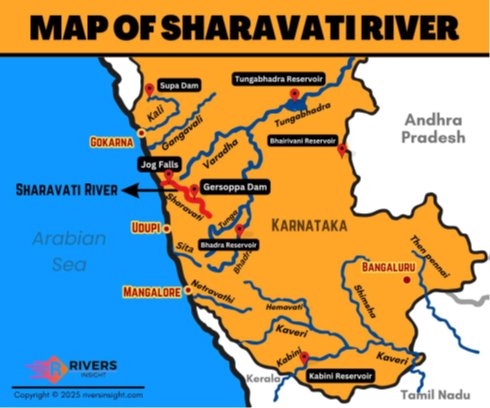
ABOUT THE SHARAVATHI RIVER
- The Sharavathi River is located in Karnataka.
- Key facts:
- One of the few west-flowing rivers in India
- Originates in the Western Ghats
- Flows northwest and drains into the Arabian Sea at Honnavar
- Total length: 128 km
- The river forms the famous Jog Falls, one of the highest waterfalls in India.
- Height of the falls: 253 metres.
MAJOR TRIBUTARIES OF SHARAVATHI
Important tributaries include:
- Nandihole
- Haridravathi
- Mavinahole
- Hilkunji
- Yennehole
- Hurlihole
- Nagodihole
ABOUT NATIONAL BOARD FOR WILDLIFE
- The National Board for Wildlife (NBWL) is a statutory body established by the Central Government in 2003.
- It was constituted under Section 5A of the Wildlife (Protection) Act, 1972.
- NBWL serves as the top advisory body in India on wildlife conservation.
- It advises the government on issues related to:
- Wildlife protection
- Management of Protected Areas (PAs)
- Approval of development projects in wildlife habitats
ROLE & IMPORTANCE OF NBWL
The National Board for Wildlife guides the government in making decisions related to:
- Wildlife conservation policies
- Protection of biodiversity
- Development projects in protected areas
It plays a key role in ensuring that development activities do not harm wildlife ecosystems.
ORGANISATIONAL STRUCTURE
The NBWL is a 47-member body.
Leadership
- Chairperson: Prime Minister of India
- Vice-Chairperson: Union Minister of Environment, Forest and Climate Change
Members Include
- Chief of Army Staff
- Defence Secretary
- Expenditure Secretary of the Government of India
- Representatives from wildlife and conservation institutions
In addition, the government nominates:
- 10 eminent conservationists, ecologists and environmentalists
MEMBER SECRETARY OF NBWL
- The Additional Director General of Forests (Wildlife) and Director of Wildlife Preservation serves as the Member Secretary of the Board.
- The Member Secretary helps in:
- Coordinating meetings
- Implementing board decisions
- Managing administrative functions
MAJOR FUNCTIONS OF NBWL
- The main functions of the National Board for Wildlife include:
- Wildlife Conservation
- Advising the Central and State Governments on matters related to wildlife protection.
- Recommending strategies to control poaching and illegal wildlife trade.
- Protected Area Management
- Providing recommendations for:
- National Parks
- Wildlife Sanctuaries
- Other Protected Areas
- Environmental Impact Assessment
- Monitoring Conservation Efforts
- Preparing and publishing a Wildlife Status Report at least once every two years.
STANDING COMMITTEE OF NBWL
- The Standing Committee is a smaller body formed under the NBWL.
- Composition
- Consists of not more than 10 members
- Chairperson: Union Minister of Environment, Forest and Climate Change
ROLE OF THE STANDING COMMITTEE
- The Standing Committee mainly deals with project approvals in protected areas.
Its functions include:
- Examining development projects in wildlife sanctuaries
- Regulating land diversion in protected areas
- Reviewing activities within Eco-Sensitive Zones (ESZs)
- Thus, it acts as a project clearance authority.
DIFFERENCE BETWEEN NBWL & STANDING COMMITTEE OF NBWL
| Aspect | National Board for Wildlife (NBWL) | Standing Committee of NBWL |
| Nature | Policy-level advisory body | Project clearance body |
| Leadership | Chaired by Prime Minister | Chaired by Environment Minister |
| Role | Wildlife conservation policy and strategy | Approves projects in Protected Areas and ESZs |
| Size | 47 members | Up to 10 members |
Note: Connect with Vajirao & Reddy Institute to keep yourself updated with latest UPSC Current Affairs in English.
Note: We upload Current Affairs Except Sunday.
The post KARNATAKA HC VERDICT ON SHARAVATI PUMPED STORAGE HYDROELECTRIC PROJECT appeared first on Vajirao IAS.