MGNREGA TO VB G RAM G
Introduction
- The Union government introduced The Viksit Bharat—Guarantee for Rozgar and Ajeevika Mission (Gramin) Bill, 2025, also known as the VB-G RAM G Bill, in the Lok Sabha on December 16, 2025.
- The Bill was moved by Union Rural Development and Agriculture Minister Shivraj Singh Chouhan during the Winter Session of Parliament.
- The legislation seeks to replace the Mahatma Gandhi National Rural Employment Guarantee Act (MGNREGA), 2005.
- The Bill was taken up for discussion and debate in the Lok Sabha on December 17, 2025.
- The most significant change introduced by the Bill is the shift from a demand-driven, rights-based employment guarantee to a supply-driven, allocation-based framework.
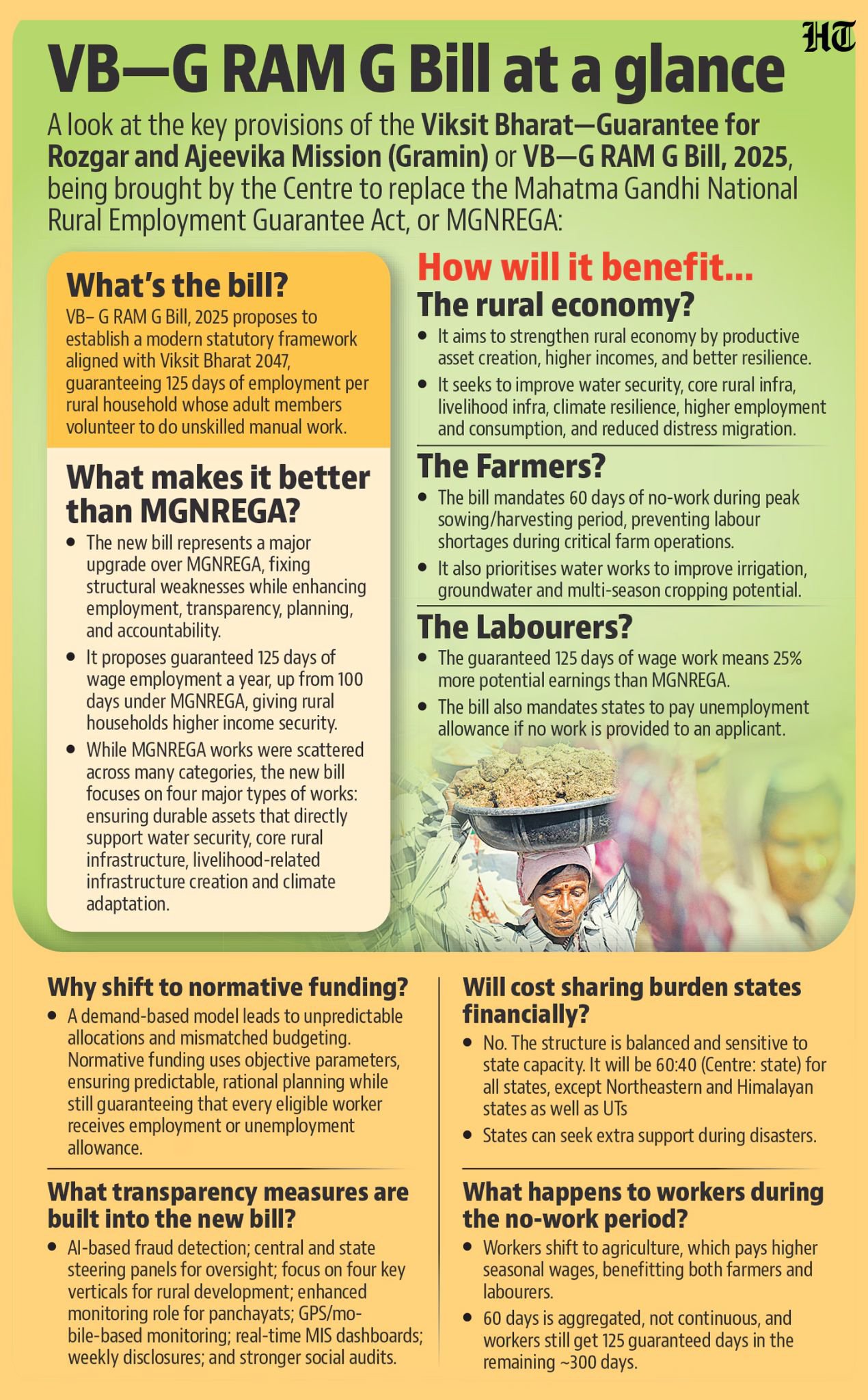
BACKGROUND: WHAT WAS MGNREGA?
- The National Rural Employment Guarantee Act (NREGA) was enacted in 2005 and was renamed MGNREGA in 2009.
- The Act provided a legal and enforceable right to work for rural households.
- Every rural household whose adult members were willing to perform unskilled manual work was entitled to at least 100 days of wage employment in a financial year.
- If employment was not provided, the worker was entitled to an unemployment allowance.
- The scheme applied to all rural areas across India, ensuring universal coverage.
- The Union government paid 100 percent of unskilled labour wages and 75 percent of material costs, which effectively resulted in a 90:10 cost-sharing ratio between the Centre and the States.
PERFORMANCE ISSUES UNDER MGNREGA
- In 2022, the Ministry of Rural Development constituted a committee to examine governance and performance issues related to MGNREGS.
- The committee submitted its report in 2024.
- The report revealed a substantial gap between the statutory guarantee of employment and actual employment provided.
- During 2024–25, the average employment generated per household was only around 50 days, despite a legal guarantee of 100 days.
- Only 40.70 lakh households completed the full 100 days of work in 2024–25.
- In the current financial year, only 6.74 lakh households have reached the 100-day employment limit.
DEMAND BY STATES TO INCREASE WORKDAYS
- Several States, including Andhra Pradesh, Madhya Pradesh, Chhattisgarh, and Rajasthan, have repeatedly demanded an increase in the 100-day work limit.
- Existing rules permit States to provide employment beyond 100 days.
- However, any employment beyond the guaranteed limit must be fully funded by the States themselves.
- Due to financial constraints, only a few States have been able to meaningfully extend employment beyond the statutory limit.
STATE CONTRIBUTION TO EMPLOYMENT GENERATION
- In 2024–25, MGNREGA generated 290 crore person-days of employment nationwide.
- Out of this total, only 4.35 crore person-days were funded by States using their own budgets.
- States that financed employment from their own resources include Maharashtra, Chhattisgarh, Odisha, Himachal Pradesh, Kerala, Rajasthan, Madhya Pradesh, and Telangana.
- This highlights the heavy dependence of rural employment generation on central funding.
CORE STRUCTURAL CHANGES UNDER VB G RAM G
- The Bill increases the statutory guarantee of wage employment from 100 days to 125 days per rural household per financial year.
- Employment under the new law will be governed by pre-determined budgetary allocations rather than worker demand.
- The scheme moves away from a rights-based entitlement toward a normative allocation system controlled by the Union government.
CHANGE IN COST SHARING PATTERN
- The Bill introduces a major shift in funding responsibility between the Centre and the States.
- For north-eastern States and Himalayan States or Union Territories, including Uttarakhand, Himachal Pradesh, and Jammu and Kashmir, the cost-sharing ratio will remain 90:10.
- For all other States and Union Territories with legislatures, the cost-sharing ratio will be 60:40.
- This change significantly increases the financial burden on State governments compared to MGNREGA.
INCREASED CENTRAL CONTROL OVER IMPLEMENTATION
- Section 4(5) of the Bill empowers the Union government to decide State-wise normative allocations for each financial year.
- These allocations will be based on parameters prescribed by the Centre.
- States will no longer have the flexibility to seek additional funds even if employment demand increases.
- Section 5(1) authorises the Centre to notify specific rural areas where the scheme will be implemented.
- This provision ends the universal rural coverage that existed under MGNREGA.
PROVISION FOR SEASONAL PAUSE IN EMPLOYMENT
- The Bill allows the government to pause the employment guarantee for up to 60 days during peak agricultural seasons such as sowing and harvesting.
- The stated objective is to ensure adequate labour availability for agricultural activities.
- Critics argue that this provision may deprive rural workers of income support during critical periods.
THEMATIC FOCUS & INFRASTRUCTURE ORIENTATION
- Public works under the new scheme will be integrated into a Viksit Bharat National Rural Infrastructure Stack.
- The focus areas include water security, core rural infrastructure, livelihood infrastructure, and climate mitigation.
- This represents a shift toward infrastructure-oriented employment rather than purely wage support.
MANDATORY USE OF TECHNOLOGY
- The Bill legally mandates the use of biometric authentication, mobile app-based attendance, and geospatial tracking of worksites.
- These technological measures were earlier implemented administratively under MGNREGA.
- While intended to improve transparency and efficiency, concerns remain about digital exclusion, surveillance, and payment delays.
GOVERNMENT’S JUSTIFICATION
- The government argues that rural India has undergone major socio-economic transformation since 2005.
- It cites improvements in roads, housing, electrification, financial inclusion, and digital connectivity.
- The government also highlights changing aspirations of rural youth and the need for higher incomes, sustainable livelihoods, infrastructure creation, and climate resilience.
- On this basis, it claims that MGNREGA needs to be replaced by a modern and growth-oriented framework.
CRITICISMS & POLITICAL OPPOSITION
- Mazdoor Kisan Shakti Sangathan criticised the Bill, stating that it dismantles the legal right to work built over two decades.
- They argued that the Bill centralises power, weakens worker entitlements, and places an impractical financial burden on States.
- The NREGA Sangharsh Morcha demanded the immediate withdrawal of the Bill.
- It accused the government of excessive centralisation, fixed allocations, technocratic surveillance, reduced accountability, and erosion of democratic and constitutional guarantees.
- The removal of “Mahatma Gandhi” from the title has also triggered political backlash from opposition parties.
CONCLUSION
The VB-G RAM G Bill represents a fundamental transformation in India’s rural employment policy. While it increases the number of guaranteed workdays, it weakens the rights-based nature of employment. The Bill raises critical questions related to social justice, federalism, centralisation, and accountability. Its final impact will depend on parliamentary scrutiny and the manner in which it is implemented across States.
Note: Connect with Vajirao & Reddy Institute to keep yourself updated with latest UPSC Current Affairs in English.
Note: We upload Current Affairs Except Sunday.
The post MGNREGA TO VB G RAM G appeared first on Vajirao IAS.