PGP Day-1 (Geography)
Quiz-summary
0 of 50 questions completed
Questions:
- 1
- 2
- 3
- 4
- 5
- 6
- 7
- 8
- 9
- 10
- 11
- 12
- 13
- 14
- 15
- 16
- 17
- 18
- 19
- 20
- 21
- 22
- 23
- 24
- 25
- 26
- 27
- 28
- 29
- 30
- 31
- 32
- 33
- 34
- 35
- 36
- 37
- 38
- 39
- 40
- 41
- 42
- 43
- 44
- 45
- 46
- 47
- 48
- 49
- 50
Information
PGP Day-1 (Geography)
You have already completed the quiz before. Hence you can not start it again.
Quiz is loading…
You must sign in or sign up to start the quiz.
You have to finish following quiz, to start this quiz:
Results
0 of 50 questions answered correctly
Your time:
Time has elapsed
You have reached 0 of 0 points, (0)
Categories
-
Not categorized
0%
- 1
- 2
- 3
- 4
- 5
- 6
- 7
- 8
- 9
- 10
- 11
- 12
- 13
- 14
- 15
- 16
- 17
- 18
- 19
- 20
- 21
- 22
- 23
- 24
- 25
- 26
- 27
- 28
- 29
- 30
- 31
- 32
- 33
- 34
- 35
- 36
- 37
- 38
- 39
- 40
- 41
- 42
- 43
- 44
- 45
- 46
- 47
- 48
- 49
- 50
-
Answered -
Review
-
Question 1 of 50
1. Question
As per the theory of plate tectonics, the cycle of convections cells is responsible for the movement of the plates. The sources of heat within the earth responsible for the cycle of convection cell is/are:
1. Radioactive decay
2. Residual heat from earth formation
3. Solar radiations
Select the correct answer using the code given below:
CorrectAnswer: C
Explanation:
Statement 1 and 2 are correct:
-
- As per the plate tectonic theory, the surface of the earth and the interior are not static and motionless but are dynamic. The mobile rock beneath the rigid plates is believed to be moving circularly. The heated material rises to the surface, spreads, and begins to cool, and then sinks backs into deeper depths. This cycle is repeated over and over to generate what scientists call a convictive flow. Heat within the earth comes from two main sources: radioactive decay and residual heat.
IncorrectAnswer: C
Explanation:
Statement 1 and 2 are correct:
-
- As per the plate tectonic theory, the surface of the earth and the interior are not static and motionless but are dynamic. The mobile rock beneath the rigid plates is believed to be moving circularly. The heated material rises to the surface, spreads, and begins to cool, and then sinks backs into deeper depths. This cycle is repeated over and over to generate what scientists call a convictive flow. Heat within the earth comes from two main sources: radioactive decay and residual heat.
-
-
Question 2 of 50
2. Question
Consider the following passage:
“These are characterized by outbreaks of cooler and more viscous lavas than basalt. They are constructed from numerous explosive eruptions. Pyroclastic material and ashes find their way to the ground along with Lava“.
Which of the following types of volcanoes is being referred to in the above passage?
CorrectAnswer: D
Explanation:
-
- Composite volcano is conical with a concave shape that is steeper near the top. These mountains commonly have snow-covered peaks standing high above the surrounding mountainous terrain. Composite volcanoes are large volcanoes (many thousands of feet or meters tall) generally composed of lava flows, pyroclastic deposits, and mudflow (lahar) deposits, as well as lava domes. Composite volcanoes are active over long periods (tens to hundreds of thousands of years) and erupt periodically. Example: Mount Rainier is an active volcano and the tallest peak in the Pacific Northwest.
- Caldera – large depression formed when a volcano erupts and collapses. Example: Crater Lake in Oregon.
- Mid Ocean ridge volcanoes is a seafloor mountain system formed by plate tectonics, typically has a depth of about 2,600 meters and rises about 2,000 meters above the deepest portion of an ocean basin. Examples: The Mid-Indian Ocean Ridge, Carlsberg Ridge, Pacific-Antarctic Ridge, and the East Pacific Rise.
- A shield volcano is a type of volcano named for its low profile, resembling a warrior shield lying on the ground, highly fluid lava. Examples: Mauna Kea and Mauna Loa.
IncorrectAnswer: D
Explanation:
-
- Composite volcano is conical with a concave shape that is steeper near the top. These mountains commonly have snow-covered peaks standing high above the surrounding mountainous terrain. Composite volcanoes are large volcanoes (many thousands of feet or meters tall) generally composed of lava flows, pyroclastic deposits, and mudflow (lahar) deposits, as well as lava domes. Composite volcanoes are active over long periods (tens to hundreds of thousands of years) and erupt periodically. Example: Mount Rainier is an active volcano and the tallest peak in the Pacific Northwest.
- Caldera – large depression formed when a volcano erupts and collapses. Example: Crater Lake in Oregon.
- Mid Ocean ridge volcanoes is a seafloor mountain system formed by plate tectonics, typically has a depth of about 2,600 meters and rises about 2,000 meters above the deepest portion of an ocean basin. Examples: The Mid-Indian Ocean Ridge, Carlsberg Ridge, Pacific-Antarctic Ridge, and the East Pacific Rise.
- A shield volcano is a type of volcano named for its low profile, resembling a warrior shield lying on the ground, highly fluid lava. Examples: Mauna Kea and Mauna Loa.
-
-
Question 3 of 50
3. Question
Which of the following can induce an earthquake?
1. Sliding of tectonic plates along a fault plain
2. The collapse of roofs of underground mines
3. Volcanic eruption
4. Tsunamis
Select the correct answer using the code given below:
CorrectAnswer: B
Explanation:
Types of Earthquakes
-
- The most common ones are the tectonic earthquakes. These are generated due to sliding of rocks along a fault plane.
- A special class of tectonic earthquakes is sometimes recognized as volcanic earthquakes. However, these are confined to areas of active volcanoes.
- In the areas of intense mining activity, sometimes the roofs of underground mines collapse causing minor tremors. These are called collapse earthquakes.
- Ground shaking may also occur due to the explosion of chemical or nuclear devices. Such tremors are called explosion earthquakes.
- The earthquakes that occur in the areas of large reservoirs are referred to as reservoir induced earthquakes.
IncorrectAnswer: B
Explanation:
Types of Earthquakes
-
- The most common ones are the tectonic earthquakes. These are generated due to sliding of rocks along a fault plane.
- A special class of tectonic earthquakes is sometimes recognized as volcanic earthquakes. However, these are confined to areas of active volcanoes.
- In the areas of intense mining activity, sometimes the roofs of underground mines collapse causing minor tremors. These are called collapse earthquakes.
- Ground shaking may also occur due to the explosion of chemical or nuclear devices. Such tremors are called explosion earthquakes.
- The earthquakes that occur in the areas of large reservoirs are referred to as reservoir induced earthquakes.
-
-
Question 4 of 50
4. Question
Consider the following statements about the terrestrial planet?
1. The terrestrial planets were formed in the close vicinity of the parent star where it was too warm for gases to condense to solid particles.
2. The solar wind was most intense nearer the sun; so, it blew off lots of gas and dust from the terrestrial planets.
Which of the statements given above is/are correct?
CorrectAnswer: C
Explanation:
-
- The terrestrial planets were formed in the close vicinity of the parent star where it was too warm for gases to condense to solid particles.
- The solar wind was most intense nearer the sun; so, it blew off lots of gas and dust from the terrestrial planets.
- The terrestrial planets are smaller, and their lower gravity could not hold the escaping gases.
IncorrectAnswer: C
Explanation:
-
- The terrestrial planets were formed in the close vicinity of the parent star where it was too warm for gases to condense to solid particles.
- The solar wind was most intense nearer the sun; so, it blew off lots of gas and dust from the terrestrial planets.
- The terrestrial planets are smaller, and their lower gravity could not hold the escaping gases.
-
-
Question 5 of 50
5. Question
Consider the following about Big Bang Theory:
1. Big Bang theory is also called the expanding universe hypothesis.
2. The expansion of the universe does not mean an increase in space between the galaxies.
3. Primordial elements -hydrogen, helium and lithium – condense through gravity that formed early stars and galaxies.
Which of the statements given above is/are correct?
CorrectAnswer: D
Explanation:
-
- Big Bang theory is also called the expanding universe hypothesis. Edwin Hubble, in 1920, provided evidence that the universe is expanding. As time passes, galaxies move further and further apart.
- Space between the galaxies is increasing, but does not support the expansion of galaxies.
- Primordial elements -hydrogen, helium and lithium – condense through gravity that formed early stars and galaxies.
IncorrectAnswer: D
Explanation:
-
- Big Bang theory is also called the expanding universe hypothesis. Edwin Hubble, in 1920, provided evidence that the universe is expanding. As time passes, galaxies move further and further apart.
- Space between the galaxies is increasing, but does not support the expansion of galaxies.
- Primordial elements -hydrogen, helium and lithium – condense through gravity that formed early stars and galaxies.
-
-
Question 6 of 50
6. Question
Which of the following countries is most likely to adopt multiple time zones?
CorrectAnswer: A
Explanation:
-
- Countries having large longitudinal spread can adopt several time zones. Like Russia, which extends through almost 165-degree of latitude, it is divided into 11 time zones. Similarly, the USA and Canada are divided into 5 time zones.
- Countries with large latitudinal spread but limited longitudinal spread may adopt single time zones. Like India, which spread across almost 300-degree latitudes has adopted a single time zone. It has adopted 82.50 east for the standard time which is 5 hours and 30 minutes ahead of Greenwich meantime.
- A country with very small latitudinal or longitudinal expense may have large altitudinal variation.
- Location of a country with respect to the equator does not have any correlation with adoption of multiple time zones. One country in the arctic zone may adopt a single time zone if its longitudinal spread is small.
IncorrectAnswer: A
Explanation:
-
- Countries having large longitudinal spread can adopt several time zones. Like Russia, which extends through almost 165-degree of latitude, it is divided into 11 time zones. Similarly, the USA and Canada are divided into 5 time zones.
- Countries with large latitudinal spread but limited longitudinal spread may adopt single time zones. Like India, which spread across almost 300-degree latitudes has adopted a single time zone. It has adopted 82.50 east for the standard time which is 5 hours and 30 minutes ahead of Greenwich meantime.
- A country with very small latitudinal or longitudinal expense may have large altitudinal variation.
- Location of a country with respect to the equator does not have any correlation with adoption of multiple time zones. One country in the arctic zone may adopt a single time zone if its longitudinal spread is small.
-
-
Question 7 of 50
7. Question
Consider the following statements about ‘Residual Mountains’:
1. These mountains evolved by denudation and are called mountains of denudation.
2. Aravalli and all the mountains of the peninsula are residual mountains.
3. They form those portions of old plateau which have escaped weathering.
Which of the statements given above are correct?
CorrectAnswer: C
Explanation:
Residual mountains are the remnants of previously existing mountains that have been subjected to weathering and erosion for an extended period. The residual mountains owe their current shape to erosion by rivers, glaciers, wind, etc. Example: Girnar hills, Nilgiri hills, and Sierra of Spain.
-
- All mountains of the peninsula with the exception of the Aravallis are relict mountains.
- They form those portions of old plateau which have escaped weathering. The residual mountains stand alone in the surroundings area reduced in height. They may be part of an upland eroded to form a number of hills.
IncorrectAnswer: C
Explanation:
Residual mountains are the remnants of previously existing mountains that have been subjected to weathering and erosion for an extended period. The residual mountains owe their current shape to erosion by rivers, glaciers, wind, etc. Example: Girnar hills, Nilgiri hills, and Sierra of Spain.
-
- All mountains of the peninsula with the exception of the Aravallis are relict mountains.
- They form those portions of old plateau which have escaped weathering. The residual mountains stand alone in the surroundings area reduced in height. They may be part of an upland eroded to form a number of hills.
-
-
Question 8 of 50
8. Question
The ‘Big Splat Event’ is associated with the formation of:
CorrectAnswer: A
Explanation:
-
- The ‘Big Splat Event’ states that an object the size of mars collided with the early earth to create the moon.
IncorrectAnswer: A
Explanation:
-
- The ‘Big Splat Event’ states that an object the size of mars collided with the early earth to create the moon.
-
-
Question 9 of 50
9. Question
Which of the following can be classified as an intrusive landform?
1. Batholith
2. Lapoliths
3. Sills
4. Dykes
Select the correct answer using the code given below:
CorrectAnswer: D
Explanation:
Intrusive landforms are formed when magma cools down within the crust.
-
- Intrusive features like batholith stocks, lapoliths, laccoliths, sills and dykes are formed. Its conduits are implied after an eruption they can collapse in the formation of caldera or remain as lava tubes and caves. The mass of cooling magma is called pluton and rock around is known as country rock.
IncorrectAnswer: D
Explanation:
Intrusive landforms are formed when magma cools down within the crust.
-
- Intrusive features like batholith stocks, lapoliths, laccoliths, sills and dykes are formed. Its conduits are implied after an eruption they can collapse in the formation of caldera or remain as lava tubes and caves. The mass of cooling magma is called pluton and rock around is known as country rock.
-
-
Question 10 of 50
10. Question
Which of the following phenomena explain the hypothesis of seafloor spreading?
1. Similar magnetic properties of rocks equidistant on either side of the crust of the mid oceanic ridges.
2. The ocean crust rocks are much younger than the continental rocks.
3. The occurrence of shallow-foci earthquakes along mid oceanic ridges.
Which of the statements given above are correct?
CorrectAnswer: D
Explanation:
-
- The rocks equidistant on either side of the crest of mid-oceanic ridges show remarkable similarities in terms of period of formation, chemical compositions and magnetic properties.
- Rocks closer to the mid-oceanic ridges have normal polarity and are the youngest. The age of the rocks increases as one moves away from the crest.
- The ocean crust rocks are much younger than the continental rocks. The age of rocks in the oceanic crust is nowhere more than 200 million years old.
- The sediments on the ocean floor are unexpectedly very thin. Scientists were expecting, if the ocean floors were as old as the continent.
- The deep trenches have deep-seated earthquake occurrences while in the mid oceanic ridge areas, the quake foci have shallow depths.
IncorrectAnswer: D
Explanation:
-
- The rocks equidistant on either side of the crest of mid-oceanic ridges show remarkable similarities in terms of period of formation, chemical compositions and magnetic properties.
- Rocks closer to the mid-oceanic ridges have normal polarity and are the youngest. The age of the rocks increases as one moves away from the crest.
- The ocean crust rocks are much younger than the continental rocks. The age of rocks in the oceanic crust is nowhere more than 200 million years old.
- The sediments on the ocean floor are unexpectedly very thin. Scientists were expecting, if the ocean floors were as old as the continent.
- The deep trenches have deep-seated earthquake occurrences while in the mid oceanic ridge areas, the quake foci have shallow depths.
-
-
Question 11 of 50
11. Question
Consider the following pairs about the layers of earth and their composition:
Layers Compositions
1. Continental Crust Silicon and Iron
2. Ocean Crust Silicon and Aluminum
3. Mantle Olivine
4. Core Nickel and Iron
How many pairs given above are correctly matched?
CorrectAnswer: B
Explanation:
-
- Continental crust is mostly composed of different types of granites also referred to as SIAL (Silicon and Aluminum).
- Oceanic crust is made up of SIMA (Silicon and Magnesium).
- Mantle is made of silicon – a wide variety of compounds that share silicon and ocean structure and composition of over 50% of olivine and high pressure – Mg rich olivine. Therefore, the third pair is correct.
- Core is made almost entirely of metal – specifically iron and nickel alloy is simply the element ‘chemical’ – NiFe. Therefore, the fourth pair is correct.
IncorrectAnswer: B
Explanation:
-
- Continental crust is mostly composed of different types of granites also referred to as SIAL (Silicon and Aluminum).
- Oceanic crust is made up of SIMA (Silicon and Magnesium).
- Mantle is made of silicon – a wide variety of compounds that share silicon and ocean structure and composition of over 50% of olivine and high pressure – Mg rich olivine. Therefore, the third pair is correct.
- Core is made almost entirely of metal – specifically iron and nickel alloy is simply the element ‘chemical’ – NiFe. Therefore, the fourth pair is correct.
-
-
Question 12 of 50
12. Question
Which of the following constitute(s) as a direct source(s) of information about the interior of the earth?
1. Volcanic Eruption
2. Meteors
3. Earthquake
Select the correct answer using the code given below:
CorrectAnswer: A
Explanation:
-
- Mining drilling and volcanic eruptions are examples of direct sources. During the process of mining and drilling rocks and minerals are extracted which gives information that there is a layer system in the crust.
- Volcanic eruption suggests that there is the same zone inside the earth which is very hot and liquid.
- Seismic waves, gravitational fields, magnetic fields, falling meteors etc. are examples of indirect sources.
They are very important for knowing about the earth’ interior.
IncorrectAnswer: A
Explanation:
-
- Mining drilling and volcanic eruptions are examples of direct sources. During the process of mining and drilling rocks and minerals are extracted which gives information that there is a layer system in the crust.
- Volcanic eruption suggests that there is the same zone inside the earth which is very hot and liquid.
- Seismic waves, gravitational fields, magnetic fields, falling meteors etc. are examples of indirect sources.
They are very important for knowing about the earth’ interior.
-
-
Question 13 of 50
13. Question
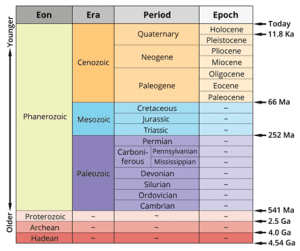
Arrange the following geological timespan in descending order:
1. Eon
2. Era
3. Period
4. Epoch
Select the correct answer using the code given below:
CorrectAnswer: A
Explanation:
Refer to the image given below:
IncorrectAnswer: A
Explanation:
Refer to the image given below:
-
-
Question 14 of 50
14. Question
Consider the following statements about igneous rocks:
1. They are formed as a result of recrystallization and reorganization of material within rocks.
2. The texture of these rocks is dependent on the rate of cooling of magma.
3. Gabbro and pegmatite belong to the igneous rocks.
Which of the statements given above is/are correct?
CorrectAnswer: C
Explanation:
-
- Igneous rocks form out of magma and lava from the interior of the earth, they are known as primary rocks.
- Igneous rocks are classified based on texture. Texture depends upon size and arrangement of grains or other physical conditions of the materials.
- Molten material is cooled slowly at great depths, mineral grains may be very large.
- Granite, gabbro, pegmatite, basalt, volcanic breccia and tuff are some of the examples of igneous rocks.
- Generally, rocks get metamorphosed when the crystal in the original rock gets recrystallized, hence option 1 is incorrect.
IncorrectAnswer: C
Explanation:
-
- Igneous rocks form out of magma and lava from the interior of the earth, they are known as primary rocks.
- Igneous rocks are classified based on texture. Texture depends upon size and arrangement of grains or other physical conditions of the materials.
- Molten material is cooled slowly at great depths, mineral grains may be very large.
- Granite, gabbro, pegmatite, basalt, volcanic breccia and tuff are some of the examples of igneous rocks.
- Generally, rocks get metamorphosed when the crystal in the original rock gets recrystallized, hence option 1 is incorrect.
-
-
Question 15 of 50
15. Question
Consider the following statements regarding the nebular hypothesis:
1. According to the hypothesis, the planets were formed out of a cloud of material associated with a slowly rotating youthful sun.
2. It helps in explaining the origin of the solar system.
3. The major contribution to this theory was done by Immanuel Kant and Laplace.
Which of the statements given above are correct?
CorrectAnswer: D
Explanation:
-
- Nebular hypothesis – was first published by Immanuel Kant ‘Universal Natural History and Theory of Heavens’ (1755) and then modified by Pierre Laplace (1796).
- He assumed that there was a massive and hot gaseous nebula somewhere in space. As a result of this assumption, he was able to address the nebula heat problem.
- The massive and hot nebula was rotating or spinning on its own axis from the beginning, slowly reducing the heat.
IncorrectAnswer: D
Explanation:
-
- Nebular hypothesis – was first published by Immanuel Kant ‘Universal Natural History and Theory of Heavens’ (1755) and then modified by Pierre Laplace (1796).
- He assumed that there was a massive and hot gaseous nebula somewhere in space. As a result of this assumption, he was able to address the nebula heat problem.
- The massive and hot nebula was rotating or spinning on its own axis from the beginning, slowly reducing the heat.
-
-
Question 16 of 50
16. Question
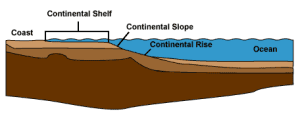
Arrange the following sections of ocean relief as they occur from coast to the deep sea:
1. Continental Slope
2. Continental Rise
3. Abyssal Plain
4. Continental Shelf
Select the correct answer using the code given below:
CorrectAnswer: B
Explanation:
Refer to the image given below:
IncorrectAnswer: B
Explanation:
Refer to the image given below:
-
-
Question 17 of 50
17. Question
In the context of an earthquake, consider the following statements regarding P-waves and S-waves:
1. While P waves create trough and crest in the material through which they pass, S-waves lead to stretching and squeezing of the material.
2. While P-waves can travel through gasses, liquids and solids, S-waves can only travel through solids.
Which of the statements given above is/are correct?
CorrectAnswer: B
Explanation:
-
- There are two types of body waves. They are called P and S-waves.
- P-waves move faster and are the first to arrive at the surface. These are also called ’primary waves’. The P-waves are similar to sound waves. They travel through gaseous, liquid, and solid materials.
- S-waves arrive at the surface with some time lag.
- S-waves are also called secondary waves. They can travel only through solid materials. This characteristic of S-waves helped scientists to understand the structure of the interior of the earth.
IncorrectAnswer: B
Explanation:
-
- There are two types of body waves. They are called P and S-waves.
- P-waves move faster and are the first to arrive at the surface. These are also called ’primary waves’. The P-waves are similar to sound waves. They travel through gaseous, liquid, and solid materials.
- S-waves arrive at the surface with some time lag.
- S-waves are also called secondary waves. They can travel only through solid materials. This characteristic of S-waves helped scientists to understand the structure of the interior of the earth.
-
-
Question 18 of 50
18. Question
Consider the following statements regarding Continental Drift Theory:
1. It was introduced by Arthur Holmes in 1912.
2. According to the theory, all the continents formed a single continental mass with a mega ocean surrounding it.
3. It gave an account of the forces responsible for drifting of the continentals.
Which of the statements given above is/are correct?
CorrectAnswer: C
Explanation:
-
- It was proposed by Alfred Wegner, hence statement 1 is incorrect.
- According to continental drift theory there was one big landmass which he called Pangea, and which was covered by one big ocean called Panthalassa, hence statement 2 is correct.
- He had given pole-fleeing force (due to centrifugal force caused by earth’s rotation) and buoyancy force (ship floats in water due to buoyant force offered by water) but later found that they were inadequate to explain the movement of continents.
IncorrectAnswer: C
Explanation:
-
- It was proposed by Alfred Wegner, hence statement 1 is incorrect.
- According to continental drift theory there was one big landmass which he called Pangea, and which was covered by one big ocean called Panthalassa, hence statement 2 is correct.
- He had given pole-fleeing force (due to centrifugal force caused by earth’s rotation) and buoyancy force (ship floats in water due to buoyant force offered by water) but later found that they were inadequate to explain the movement of continents.
-
-
Question 19 of 50
19. Question
Which of the following are correct with reference to tropical cyclones?
1. Sea surface with a temperature above 270C hinders the formation of the cyclones.
2. The eye of the cyclones is a region of calm and subsiding air.
3. The Coriolis effect made by the earth rotation causes the wind to rotate and warm air rises quickly.
Select the correct answer using the code given below:
CorrectAnswer: C
Explanation:
-
- Tropical cyclones are known with different names: typhons, tropical storm, cyclonic storm, hurricane and tropical depression.
- A source of warm, moist air drives from tropical oceans with the surface temperature normally in the region of, or in excess, of 270
- The eye of the cyclones is a region of calm and subsiding air.
- Tropical cyclones do not form over the equator because the Coriolis force is zero at the equator. Even though the equator is a zone of wind convergence, it has nothing to do with tropical cyclones as such.
- The Coriolis effect made by the earth rotation causes the wind to rotate and warm air rises quickly.
IncorrectAnswer: C
Explanation:
-
- Tropical cyclones are known with different names: typhons, tropical storm, cyclonic storm, hurricane and tropical depression.
- A source of warm, moist air drives from tropical oceans with the surface temperature normally in the region of, or in excess, of 270
- The eye of the cyclones is a region of calm and subsiding air.
- Tropical cyclones do not form over the equator because the Coriolis force is zero at the equator. Even though the equator is a zone of wind convergence, it has nothing to do with tropical cyclones as such.
- The Coriolis effect made by the earth rotation causes the wind to rotate and warm air rises quickly.
-
-
Question 20 of 50
20. Question
Seismic gas refers to:
CorrectAnswer: B
Explanation:
-
- Sections of plate boundaries that have not ruptured in the recent past.
- A seismic gap is a segment of an active fault known to produce significant earthquakes that has not slipped in an unusually long time, compared with other segments along the same structure.
- It is known that there are numbers of “seismic gaps” in the Himalaya with a potential to slip and produce greater than 7.5 magnitude earthquakes.
IncorrectAnswer: B
Explanation:
-
- Sections of plate boundaries that have not ruptured in the recent past.
- A seismic gap is a segment of an active fault known to produce significant earthquakes that has not slipped in an unusually long time, compared with other segments along the same structure.
- It is known that there are numbers of “seismic gaps” in the Himalaya with a potential to slip and produce greater than 7.5 magnitude earthquakes.
-
-
Question 21 of 50
21. Question
Consider the following statements:
1. Magnesium, Iron and silica are major elements of it.
2. It is used in jewellery.
3. It is usually a greenish crystal, often found in basaltic rocks.
Which of the following minerals is described in the above statements?
CorrectAnswer: D
Explanation:
Option D is correct.
Olivine is the name of a group of rock-forming minerals that are typically found in mafic and ultramafic igneous rocks such as basalt, gabbro, dunite, diabase, and peridotite. Most olivine found at Earth’s surface is in dark-colored igneous rocks. It usually crystallizes in the presence of plagioclase and pyroxene to form gabbro or basalt. These types of rocks are most common at divergent plate boundaries and at hot spots within the centers of tectonic plates. Olivine has a very high crystallization temperature compared to other minerals. That makes it one of the first minerals to crystallize from a magma. Magnesium, iron and silica are major elements of olivine. It is used in jewellery. It is usually a greenish crystal, often found in basaltic rocks.
IncorrectAnswer: D
Explanation:
Option D is correct.
Olivine is the name of a group of rock-forming minerals that are typically found in mafic and ultramafic igneous rocks such as basalt, gabbro, dunite, diabase, and peridotite. Most olivine found at Earth’s surface is in dark-colored igneous rocks. It usually crystallizes in the presence of plagioclase and pyroxene to form gabbro or basalt. These types of rocks are most common at divergent plate boundaries and at hot spots within the centers of tectonic plates. Olivine has a very high crystallization temperature compared to other minerals. That makes it one of the first minerals to crystallize from a magma. Magnesium, iron and silica are major elements of olivine. It is used in jewellery. It is usually a greenish crystal, often found in basaltic rocks.
-
-
Question 22 of 50
22. Question
Hypothetically, if someone is travelling from the surface of the earth to the centre of the earth, which of the following can be observed?
1. Density of material goes on increasing.
2. Temperature goes on increasing.
3. Pressure goes on decreasing.
Select the correct answer using the code given below:
CorrectAnswer: B
Explanation:
-
- From the surface of the earth towards the centre, density of rocks, temperature and pressure increases.
IncorrectAnswer: B
Explanation:
-
- From the surface of the earth towards the centre, density of rocks, temperature and pressure increases.
-
-
Question 23 of 50
23. Question
Which of the given minerals is the component of sand and granite?
CorrectAnswer: C
Explanation:
Quartz is one of the important components of sand and granite. It consists of silica. It is a hard mineral virtually insoluble in water. It is white or colourless and used in radio and radar. It is also one of the most important components of granite.
IncorrectAnswer: C
Explanation:
Quartz is one of the important components of sand and granite. It consists of silica. It is a hard mineral virtually insoluble in water. It is white or colourless and used in radio and radar. It is also one of the most important components of granite.
-
-
Question 24 of 50
24. Question
Which of the following could be the possible reasons for an earthquake?
1. Abrupt movement of rocks along the fault.
2. Nuclear test
3. Large reservoir due to dam across the river
4. Volcanic eruption
5. Intense mining activity
Select the correct answer using the code given below:
CorrectAnswer: D
Explanation:
Types of earthquake:
1. The most common ones are the tectonic earthquakes. These are generated due to sliding of rocks along a fault plane.
2. A special class of tectonic earthquakes is sometimes recognised as volcanic earthquakes. However, these are confined to areas of active volcanoes.
3. In the areas of intense mining activity, sometimes the roofs of underground mines collapse causing minor tremors. These are called collapse earthquakes.
4. Ground shaking may also occur due to the explosion of chemical or nuclear devices. Such tremors are called explosion earthquakes.
5. The earthquakes that occur in the areas of large reservoirs are referred to as reservoir induced earthquakes.
IncorrectAnswer: D
Explanation:
Types of earthquake:
1. The most common ones are the tectonic earthquakes. These are generated due to sliding of rocks along a fault plane.
2. A special class of tectonic earthquakes is sometimes recognised as volcanic earthquakes. However, these are confined to areas of active volcanoes.
3. In the areas of intense mining activity, sometimes the roofs of underground mines collapse causing minor tremors. These are called collapse earthquakes.
4. Ground shaking may also occur due to the explosion of chemical or nuclear devices. Such tremors are called explosion earthquakes.
5. The earthquakes that occur in the areas of large reservoirs are referred to as reservoir induced earthquakes.
-
-
Question 25 of 50
25. Question
Consider the following kinds of rocks:
1. Sandstone
2. Slate
3. Shale
4. Schist
Which of the above-mentioned rocks are metamorphic rocks?
CorrectAnswer: C
Explanation: Sedimentary rocks are formed from sediment accumulated over long periods, usually underwater. They are distinguished from the other rock types in their characteristic layer formation and are termed stratified rocks.
-
- Examples of metamorphic rocks: Gneissoid, granite, syenite, slate, schist, marble, quartzite.
- Examples of Igneous rocks: Granite, gabbro, pegmatite, basalt, volcanic breccia and tuff.
- Examples of sedimentary rocks: (i) mechanically formed — sandstone, conglomerate, limestone, shale, loess etc. are examples; (ii) organically formed — geyserite, chalk, limestone, coal etc. are some examples; (iii) chemically formed —chert, limestone, halite, potash.
IncorrectAnswer: C
Explanation: Sedimentary rocks are formed from sediment accumulated over long periods, usually underwater. They are distinguished from the other rock types in their characteristic layer formation and are termed stratified rocks.
-
- Examples of metamorphic rocks: Gneissoid, granite, syenite, slate, schist, marble, quartzite.
- Examples of Igneous rocks: Granite, gabbro, pegmatite, basalt, volcanic breccia and tuff.
- Examples of sedimentary rocks: (i) mechanically formed — sandstone, conglomerate, limestone, shale, loess etc. are examples; (ii) organically formed — geyserite, chalk, limestone, coal etc. are some examples; (iii) chemically formed —chert, limestone, halite, potash.
-
-
Question 26 of 50
26. Question
Consider the following statements:
Assertion (A): Earthquakes with higher value on the Richter scale can have lower value on the Mercalli scale.
Reason (R): Mercalli scale takes into account the visible damage caused by the event while Richter scale measures the magnitude of earthquake.
In the context of the above statements, which of the following is correct?
CorrectAnswer: A
Explanation:
-
- The earthquake events are scaled either according to the magnitude or intensity of the shock. The magnitude scale is known as the Richter scale. The magnitude relates to the energy released during the quake. The magnitude is expressed in numbers, 0-10. The intensity scale is named after Mercalli, an Italian seismologist. The intensity scale takes into account the visible damage caused by the event. The range of intensity scale is from 1-12.
- If a high magnitude earthquake happens in a place where there is no human habitation, there will be very less or no loss to human life and property. Therefore, such earthquakes will have higher value on the Richter scale but low value on Mercalli scale.
IncorrectAnswer: A
Explanation:
-
- The earthquake events are scaled either according to the magnitude or intensity of the shock. The magnitude scale is known as the Richter scale. The magnitude relates to the energy released during the quake. The magnitude is expressed in numbers, 0-10. The intensity scale is named after Mercalli, an Italian seismologist. The intensity scale takes into account the visible damage caused by the event. The range of intensity scale is from 1-12.
- If a high magnitude earthquake happens in a place where there is no human habitation, there will be very less or no loss to human life and property. Therefore, such earthquakes will have higher value on the Richter scale but low value on Mercalli scale.
-
-
Question 27 of 50
27. Question
Consider the following pairs:
List-I List-II
1. Asthenosphere – Source of magma
2. Lithosphere – Tectonic activities
3. Barysphere – Soil formation
4. Cryosphere – Polar ice
How many pairs given above are correctly matched?
CorrectAnswer: C
Explanation:
Please refer to the table given below:
List-I List-II Asthenosphere Source of magma Lithosphere Most of the tectonic activities occur in lithosphere Barysphere Core area of earth’s interior Cryosphere Polar ice
IncorrectAnswer: C
Explanation:
Please refer to the table given below:
List-I List-II Asthenosphere Source of magma Lithosphere Most of the tectonic activities occur in lithosphere Barysphere Core area of earth’s interior Cryosphere Polar ice
-
-
Question 28 of 50
28. Question
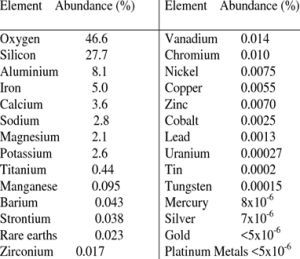
Arrange the given elements in the increasing order of their abundance inside the earth’s crust.
1. Potassium
2. Silicon
3. Iron
4. Aluminium
Select the correct answer from the code given below:
CorrectAnswer: B
Explanation:
Refer to the table of most abundant elements in the Earth’s Crust given below:
IncorrectAnswer: B
Explanation:
Refer to the table of most abundant elements in the Earth’s Crust given below:
-
-
Question 29 of 50
29. Question
Which of the following statements is incorrect?
CorrectAnswer: C
Explanation:
-
- Statement 1 is correct: Rocks closer to the Mid-oceanic ridge are younger. The age of the rocks increases as one moves away from the crest of the ridge.
- Statement 2 is correct: Rocks closer to the Mid-oceanic ridge have normal polarity.
- Statement 3 is incorrect: Ocean crust rocks are younger than continental rocks. The age of rocks in the oceanic crust is nowhere more than 200 million years old. Some of the continental rock formations are as old as 3,200 million years.
- Statement 4 is correct: Oceanic crust is thinner as compared to the continental crust. The mean thickness of oceanic crust is 5 km whereas that of the continental is around 30 km. The continental crust is thicker in the areas of major mountain systems. It is as much as 70 km thick in the Himalayan region.
IncorrectAnswer: C
Explanation:
-
- Statement 1 is correct: Rocks closer to the Mid-oceanic ridge are younger. The age of the rocks increases as one moves away from the crest of the ridge.
- Statement 2 is correct: Rocks closer to the Mid-oceanic ridge have normal polarity.
- Statement 3 is incorrect: Ocean crust rocks are younger than continental rocks. The age of rocks in the oceanic crust is nowhere more than 200 million years old. Some of the continental rock formations are as old as 3,200 million years.
- Statement 4 is correct: Oceanic crust is thinner as compared to the continental crust. The mean thickness of oceanic crust is 5 km whereas that of the continental is around 30 km. The continental crust is thicker in the areas of major mountain systems. It is as much as 70 km thick in the Himalayan region.
-
-
Question 30 of 50
30. Question
Which of the following statements in the context of lithification is/are correct?
1. Only the igneous rocks can undergo the process of lithification.
2. The layers of deposits might retain their characteristics even after lithification.
Select the correct answer using the code given below:
CorrectAnswer: B
Explanation:
Statement 1 is incorrect: Igneous, Sedimentary and metamorphic rocks when exposed to denudational agents are broken up into various sizes of fragments. Such fragments when transported by various exogenous agencies and deposited forms the sedimentary rocks in a process called Lithification.
Statement 2 is correct: In many sedimentary rocks, the layers of deposits retain their characteristics even after lithification which we can observe in the layers of varying thickness in the sedimentary rocks like sandstone, shale etc.
IncorrectAnswer: B
Explanation:
Statement 1 is incorrect: Igneous, Sedimentary and metamorphic rocks when exposed to denudational agents are broken up into various sizes of fragments. Such fragments when transported by various exogenous agencies and deposited forms the sedimentary rocks in a process called Lithification.
Statement 2 is correct: In many sedimentary rocks, the layers of deposits retain their characteristics even after lithification which we can observe in the layers of varying thickness in the sedimentary rocks like sandstone, shale etc.
-
-
Question 31 of 50
31. Question
Consider the following pairs:
List-I List-II
1. Alps mountains – Continent-Continent convergence
2. Philippines islands – Ocean-Continent convergence
3. Iceland – Ocean-Ocean convergence
4. Rockies mountains – Ocean-Continent convergence
How many pairs given above are correctly matched?
CorrectAnswer: B
Explanation:
Please refer to the table given below:
List-I List-II Alps mountains Continent-Continent convergence Philippines islands Ocean-Ocean convergence Iceland It is part of Mid-Atlantic ridge (Divergent boundary) Rockies mountains Ocean-Continent convergence
IncorrectAnswer: B
Explanation:
Please refer to the table given below:
List-I List-II Alps mountains Continent-Continent convergence Philippines islands Ocean-Ocean convergence Iceland It is part of Mid-Atlantic ridge (Divergent boundary) Rockies mountains Ocean-Continent convergence
-
-
Question 32 of 50
32. Question
Consider the following statements regarding metamorphic rocks:
1. Metamorphism is a process by which already consolidated rocks undergo recrystallisation and reorganization.
2. Metamorphism occurs only when rocks are forced down to lower levels by tectonic processes.
3. Dynamic metamorphism causes significant chemical changes in the original minerals.
Which of the above given statements is/are correct?
CorrectAnswer: A
Explanation:
The word metamorphic means ‘change of form’. These rocks form under the action of pressure, volume and temperature (PVT) changes. Metamorphism occurs when rocks are forced down to lower levels by tectonic processes or when molten magma rising through the crust comes in contact with the crustal rocks or the underlying rocks are subjected to great amounts of pressure by overlying rocks. (Hence, statement 2 is incorrect).
Metamorphism is a process by which already consolidated rocks undergo recrystallisation and reorganisation of materials within original rocks (Hence, statement 1 is correct).
Mechanical disruption and reorganization of the original minerals within rocks due to breaking and crushing without any appreciable chemical changes is called dynamic metamorphism. (Hence, statement 3 is incorrect). The materials of rocks chemically alter and recrystallise due to thermal metamorphism.
IncorrectAnswer: A
Explanation:
The word metamorphic means ‘change of form’. These rocks form under the action of pressure, volume and temperature (PVT) changes. Metamorphism occurs when rocks are forced down to lower levels by tectonic processes or when molten magma rising through the crust comes in contact with the crustal rocks or the underlying rocks are subjected to great amounts of pressure by overlying rocks. (Hence, statement 2 is incorrect).
Metamorphism is a process by which already consolidated rocks undergo recrystallisation and reorganisation of materials within original rocks (Hence, statement 1 is correct).
Mechanical disruption and reorganization of the original minerals within rocks due to breaking and crushing without any appreciable chemical changes is called dynamic metamorphism. (Hence, statement 3 is incorrect). The materials of rocks chemically alter and recrystallise due to thermal metamorphism.
-
-
Question 33 of 50
33. Question
Arrange the following events in the chronological order based on the geological time scale:
1. Formation of the Himalayas
2. Formation of the Appalachian Mountains
3. Formation of Rockies Mountains
4. Formation of Ural Mountains
Select the correct answer using the code given below:
CorrectAnswer: A
Explanation:
-
- The Appalachians first formed roughly 480 million years ago during the Ordovician Period.
- Continental collisions gave rise to the Urals between 250 and 300 million years ago.
- The Rocky Mountains were created during the Laramide orogeny, a period of mountain building which started 80 million years ago, and ended 50 million years ago.
- Himalayas are formed in the Tertiary period. Indian plate collided with Asian plate about 40-50 million years ago causing rapid uplift of the Himalayas.
IncorrectAnswer: A
Explanation:
-
- The Appalachians first formed roughly 480 million years ago during the Ordovician Period.
- Continental collisions gave rise to the Urals between 250 and 300 million years ago.
- The Rocky Mountains were created during the Laramide orogeny, a period of mountain building which started 80 million years ago, and ended 50 million years ago.
- Himalayas are formed in the Tertiary period. Indian plate collided with Asian plate about 40-50 million years ago causing rapid uplift of the Himalayas.
-
-
Question 34 of 50
34. Question
Which of the following statements about diastrophism is/are correct?
1. It is an endogenic geomorphic process.
2. Epeirogeny and orogeny are diastrophic processes.
3. It does not induce metamorphism of rocks.
Select the correct answer using the code given below:
CorrectAnswer: B
Explanation:
All processes that move, elevate or build up portions of the earth’s crust come under diastrophism. Diastrophism and Volcanism are the endogenic geomorphic processes (Hence statement 1 is correct). Diastrophism include: (i) orogenic processes involving mountain building through severe folding and affecting long and narrow belts of the earth’s crust; (ii) epeirogenic processes involving uplift or warping of large parts of the earth’s crust; (iii) earthquakes involving local relatively minor movements; (iv) plate tectonics involving horizontal movements of crustal plates. (Hence statement 2 is correct).
In the process of orogeny, the crust is severely deformed into folds. Due to epeirogeny, there may be simple deformation. Orogeny is a mountain building process whereas epeirogeny is continental building process. Through the processes of orogeny, epeirogeny, earthquakes and plate tectonics, there can be faulting and fracturing of the crust. All these processes cause pressure, volume and temperature (PVT) changes which in turn induce metamorphism of rocks. (Hence statement 3 is incorrect).
IncorrectAnswer: B
Explanation:
All processes that move, elevate or build up portions of the earth’s crust come under diastrophism. Diastrophism and Volcanism are the endogenic geomorphic processes (Hence statement 1 is correct). Diastrophism include: (i) orogenic processes involving mountain building through severe folding and affecting long and narrow belts of the earth’s crust; (ii) epeirogenic processes involving uplift or warping of large parts of the earth’s crust; (iii) earthquakes involving local relatively minor movements; (iv) plate tectonics involving horizontal movements of crustal plates. (Hence statement 2 is correct).
In the process of orogeny, the crust is severely deformed into folds. Due to epeirogeny, there may be simple deformation. Orogeny is a mountain building process whereas epeirogeny is continental building process. Through the processes of orogeny, epeirogeny, earthquakes and plate tectonics, there can be faulting and fracturing of the crust. All these processes cause pressure, volume and temperature (PVT) changes which in turn induce metamorphism of rocks. (Hence statement 3 is incorrect).
-
-
Question 35 of 50
35. Question
Consider the following statements:
Assertion (A): The study of earthquake waves led to an understanding that the Outer Core is in liquid state.
Reason (R): P-waves do not pass through liquid medium.
In the context of the above statements, which of the following is correct?
CorrectAnswer: C
Explanation:
-
- The entire zone beyond 103° does not receive S-waves, and hence this zone is identified as the shadow zone of S-waves. This observation led to the discovery of the liquid outer core. However, the seismographs located beyond 142° from the epicenter, record the arrival of P-waves, but not that of S-waves. This gives clues about the solid inner core.
IncorrectAnswer: C
Explanation:
-
- The entire zone beyond 103° does not receive S-waves, and hence this zone is identified as the shadow zone of S-waves. This observation led to the discovery of the liquid outer core. However, the seismographs located beyond 142° from the epicenter, record the arrival of P-waves, but not that of S-waves. This gives clues about the solid inner core.
-
-
Question 36 of 50
36. Question
Which of the following can be considered as the most important aspect of Continental Drift theory?
CorrectAnswer: A
Explanation:
-
- The forces responsible for movement of land masses given by theory were inadequate.
- The evidence in support of the theory was not fool
- The idea that continental crust floats freely over oceanic crust was proved wrong by Plate Tectonic theory.
- The idea of horizontal movement of land masses was carried forward and retained by Plate Tectonic Theory which provides satisfactory answers to almost all questions related to past and present day distributions of oceans and continents.
IncorrectAnswer: A
Explanation:
-
- The forces responsible for movement of land masses given by theory were inadequate.
- The evidence in support of the theory was not fool
- The idea that continental crust floats freely over oceanic crust was proved wrong by Plate Tectonic theory.
- The idea of horizontal movement of land masses was carried forward and retained by Plate Tectonic Theory which provides satisfactory answers to almost all questions related to past and present day distributions of oceans and continents.
-
-
Question 37 of 50
37. Question
Which of the following is/are correctly matched pairs?
1. Cocos plate – Between South America and Pacific Plate
2. Nazca plate – Between Central America and Pacific Plate
3. Philippines plate – Between Asiatic and Pacific Plate
Select the correct answer using the code given below:
CorrectAnswer: C
Explanation:
-
- Cocos plate – Between Central America and Pacific Plate
- Nazca plate – Between South America and Pacific Plate
- Philippines plate – Between Asiatic and Pacific Plate
IncorrectAnswer: C
Explanation:
-
- Cocos plate – Between Central America and Pacific Plate
- Nazca plate – Between South America and Pacific Plate
- Philippines plate – Between Asiatic and Pacific Plate
-
-
Question 38 of 50
38. Question
Consider the following statements:
1. Exfoliation domes are formed due to thermal expansion activity.
2. Tors are formed due to Unloading of overlying rocks.
Which of the statements given above is/are correct?
CorrectAnswer: D
Explanation:
-
- Exfoliation domes and tors result due to unloading and thermal expansion respectively.
IncorrectAnswer: D
Explanation:
-
- Exfoliation domes and tors result due to unloading and thermal expansion respectively.
-
-
Question 39 of 50
39. Question
Which of the following endogenic activities may result in the formation of mountains?
1. Volcanic eruption
2. Folding
3. Faulting
4. Earthquake
Select the correct answer using the code given below:
CorrectAnswer: C
Explanation:
Mountains may be classified as:
-
- Fold mountains like the Himalayas, the Rockies, the Andes.
- Block mountains like Vosges mountains in France, the Black Forest in Germany, Vindhya and Satpura in India.
- Volcanic mountains like Cascade Range in the USA, Mount Kenya, Mount Kilimanjaro, Mount Fujiyama.
Note: Earthquakes do not result in mountains, although it can change the nature of landscape.
IncorrectAnswer: C
Explanation:
Mountains may be classified as:
-
- Fold mountains like the Himalayas, the Rockies, the Andes.
- Block mountains like Vosges mountains in France, the Black Forest in Germany, Vindhya and Satpura in India.
- Volcanic mountains like Cascade Range in the USA, Mount Kenya, Mount Kilimanjaro, Mount Fujiyama.
Note: Earthquakes do not result in mountains, although it can change the nature of landscape.
-
-
Question 40 of 50
40. Question
The geographical structure ‘nappe’ is associated with which of the following types of movement?
CorrectAnswer: A
Explanation:
-
- In geology, a nappe or thrust sheet is a large sheetlike body of rock that has been moved more than 2 km or 5 km above a thrust fault from its original position. Nappes form in compressional tectonic settings like continental collision zones or on the overriding plate in active subduction zones.
- In the Himalayas, over folds and recumbent folds are often found detached from their roots and carried a few hundred kilometres away by the tectonic forces. These detached folds are called ‘nappe.’
IncorrectAnswer: A
Explanation:
-
- In geology, a nappe or thrust sheet is a large sheetlike body of rock that has been moved more than 2 km or 5 km above a thrust fault from its original position. Nappes form in compressional tectonic settings like continental collision zones or on the overriding plate in active subduction zones.
- In the Himalayas, over folds and recumbent folds are often found detached from their roots and carried a few hundred kilometres away by the tectonic forces. These detached folds are called ‘nappe.’
-
-
Question 41 of 50
41. Question
Consider the following statements:
Assertion (A): Despite extensive volcanic eruptions, island formation seldom occurs along divergent plate boundaries.
Reason (R): Basaltic Magma flows out along the divergent plate boundary.
In the context of the above statements, which of the following is correct?
CorrectAnswer: A
Explanation:
Basaltic Magma flows out along the divergent plate boundary. It has less silica, and hence it is less viscous. It flows over a long-distance causing seafloor spreading but not volcanic islands.
While, andesitic or acidic magma flows out along the convergent boundary. Andesitic or acidic magma has more silica content, and hence it has higher viscosity. It doesn’t move quickly and also solidifies faster. This helps in building a layer over layer on a confined region giving rise to a volcanic mountain.
IncorrectAnswer: A
Explanation:
Basaltic Magma flows out along the divergent plate boundary. It has less silica, and hence it is less viscous. It flows over a long-distance causing seafloor spreading but not volcanic islands.
While, andesitic or acidic magma flows out along the convergent boundary. Andesitic or acidic magma has more silica content, and hence it has higher viscosity. It doesn’t move quickly and also solidifies faster. This helps in building a layer over layer on a confined region giving rise to a volcanic mountain.
-
-
Question 42 of 50
42. Question
Which of the following pairs is/are correctly matched?
1. Mount Stromboli – Shield volcano
2. Hawaiian volcano – Composite volcano
3. Deccan traps – Flood Basalt volcano
Select the correct answer using the code given below:
CorrectAnswer: C
Explanation:
-
- Mount Stromboli – Composite volcano
- Hawaiian volcano – Shield volcano
- Deccan traps – Flood Basalt volcano
IncorrectAnswer: C
Explanation:
-
- Mount Stromboli – Composite volcano
- Hawaiian volcano – Shield volcano
- Deccan traps – Flood Basalt volcano
-
-
Question 43 of 50
43. Question
Consider the following statements:
1. Hotspot volcanism is explained by Plate Tectonic Theory.
2. Mantle Plumes originate at the boundary between the Crust and the Mantle.
3. Deccan traps on the Indian Peninsula are formed due to Hotspot volcanism.
Which of the statements given above is/are correct?
CorrectAnswer: D
Explanation:
Hotspot volcanism is a type of volcanism that typically occurs at the interior parts of the lithospheric plates. E.g. Hawaiian Hotspot, the Yellowstone Hotspot, the Reunion Hotspot.
-
- Plate Tectonic Theory failed to satisfactorily explain Hotspot volcanism. Statement 1 is not correct.
- A mantle plume is convection of abnormally hot rock (magma) within the Earth’s mantle. Mantle plumes are formed at the core-mantle boundary where an abnormally hot plume of rock accumulates. Statement 2 is not correct.
- The mantle plume provides a continuous supply of abnormally hot magma to a fixed location in the mantle referred to as a hotspot.
- A huge eruption of this Reunion hotspot 66 million years ago is thought to have formed the Deccan Traps. Statement 3 is correct.
IncorrectAnswer: D
Explanation:
Hotspot volcanism is a type of volcanism that typically occurs at the interior parts of the lithospheric plates. E.g. Hawaiian Hotspot, the Yellowstone Hotspot, the Reunion Hotspot.
-
- Plate Tectonic Theory failed to satisfactorily explain Hotspot volcanism. Statement 1 is not correct.
- A mantle plume is convection of abnormally hot rock (magma) within the Earth’s mantle. Mantle plumes are formed at the core-mantle boundary where an abnormally hot plume of rock accumulates. Statement 2 is not correct.
- The mantle plume provides a continuous supply of abnormally hot magma to a fixed location in the mantle referred to as a hotspot.
- A huge eruption of this Reunion hotspot 66 million years ago is thought to have formed the Deccan Traps. Statement 3 is correct.
-
-
Question 44 of 50
44. Question
Consider the following statements:
Assertion (A): Tsunami waves are not noticed by ships far out in the deep sea.
Reason (R): in deep Sea, Tsunami waves have negligible amplitude as compared to their wavelength.
In the context of the above statements, which of the following is correct?
CorrectAnswer: A
Explanation:
Tsunami waves are not noticed by ships far out at sea because their amplitude is negligible when compared with their wavelength, and hence the waves go unnoticed in deep oceans. When tsunamis approach shallow water, the wave amplitude increases.
IncorrectAnswer: A
Explanation:
Tsunami waves are not noticed by ships far out at sea because their amplitude is negligible when compared with their wavelength, and hence the waves go unnoticed in deep oceans. When tsunamis approach shallow water, the wave amplitude increases.
-
-
Question 45 of 50
45. Question
Which of the following are possible consequences of an earthquake?
1. Landslide
2. Tsunami
3. Fires
4. Floods
5. Avalanche
Select the correct answer using the code given below:
CorrectAnswer: D
Explanation:
The following are the immediate hazardous effects of earthquake:
-
- Ground Shaking
- Differential ground settlement
- Land and mudslides
- Soil liquefaction
- Ground lurching
- Avalanches
- Ground displacement
- Floods from dam and levee failures
- Fires
- Structural collapse
- Falling objects
- Tsunami
IncorrectAnswer: D
Explanation:
The following are the immediate hazardous effects of earthquake:
-
- Ground Shaking
- Differential ground settlement
- Land and mudslides
- Soil liquefaction
- Ground lurching
- Avalanches
- Ground displacement
- Floods from dam and levee failures
- Fires
- Structural collapse
- Falling objects
- Tsunami
-
-
Question 46 of 50
46. Question
Consider the following statements:
1. Deep focus earthquakes are located along divergent plate boundaries.
2. Shallow focus earthquakes are common all along the mid-oceanic ridge.
3. Shallow focus earthquakes are more damaging than deep focus earthquakes.
Which of the statements given above is/are not correct?
CorrectAnswer: A
Explanation:
Statement 1 is incorrect: Shallow focus earthquakes are located along divergent plate boundaries. Deep focus earthquakes are located along the convergent plate boundaries.
Statement 2 is correct: Shallow focus earthquakes are common all along the mid-oceanic ridge.
Statement 3 is correct: Shallow focus earthquakes are more damaging than deep focus earthquakes. Seismic waves from deep quakes have to travel farther to the surface, losing energy along the way.
IncorrectAnswer: A
Explanation:
Statement 1 is incorrect: Shallow focus earthquakes are located along divergent plate boundaries. Deep focus earthquakes are located along the convergent plate boundaries.
Statement 2 is correct: Shallow focus earthquakes are common all along the mid-oceanic ridge.
Statement 3 is correct: Shallow focus earthquakes are more damaging than deep focus earthquakes. Seismic waves from deep quakes have to travel farther to the surface, losing energy along the way.
-
-
Question 47 of 50
47. Question
Consider the following pairs:
List- I List-II
1. Batholith – Cooled portion of magma chamber
2. Lapolith – Dome-shaped
3. Laccolith – Saucer-shape
4. Sill – Thick horizontal deposits
How many pairs given above are correctly matched?
CorrectAnswer: B
Explanation:
List-I List-II Batholith Cooled portion of magma chamber Lapolith Saucer shape Laccolith Dome-shape Sill Thick horizontal deposits 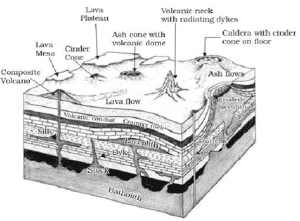
IncorrectAnswer: B
Explanation:
List-I List-II Batholith Cooled portion of magma chamber Lapolith Saucer shape Laccolith Dome-shape Sill Thick horizontal deposits
-
-
Question 48 of 50
48. Question
Interior of the Earth is divided into three parts namely- Crust, Mantle and Core. Which of the following is the correct increasing order of the volume occupied by them?
CorrectAnswer: D
Explanation:
The crust forms only 1 per cent of the volume of the earth, 84 per cent consists of the mantle and 15 per cent makes the core.
IncorrectAnswer: D
Explanation:
The crust forms only 1 per cent of the volume of the earth, 84 per cent consists of the mantle and 15 per cent makes the core.
-
-
Question 49 of 50
49. Question
Consider the following statements:
Assertion (A): Conical vent is formed in Andesitic volcanism while fissure vent is formed in Basaltic volcanism.
Reason (R): Andesitic lava is more viscous while Basaltic lava is more fluid.
In the context of the above statements, which of the following is correct?
CorrectAnswer: A
Explanation:
Andesitic/Acidic lava:
-
- Highly viscous with a high melting point.
- Light-coloured, low density and high percentage of silica.
- Flow slowly and seldom travel far before solidifying. Therefore, the resultant volcanic cone is stratified (hence the name stratovolcano) and steep-sided.
- Occurs mostly along the destructive plate boundaries.
Basaltic/Basic lava:
-
- Hottest of all lavas and are highly fluid.
- Dark coloured basalt, rich in iron and magnesium but poor in silica.
- Flow out of volcanic vents quietly and are not very explosive.
- Affect extensive areas, spreading out as thin sheets over great distances before they solidify.
- Common along the constructive plate boundaries.
IncorrectAnswer: A
Explanation:
Andesitic/Acidic lava:
-
- Highly viscous with a high melting point.
- Light-coloured, low density and high percentage of silica.
- Flow slowly and seldom travel far before solidifying. Therefore, the resultant volcanic cone is stratified (hence the name stratovolcano) and steep-sided.
- Occurs mostly along the destructive plate boundaries.
Basaltic/Basic lava:
-
- Hottest of all lavas and are highly fluid.
- Dark coloured basalt, rich in iron and magnesium but poor in silica.
- Flow out of volcanic vents quietly and are not very explosive.
- Affect extensive areas, spreading out as thin sheets over great distances before they solidify.
- Common along the constructive plate boundaries.
-
-
Question 50 of 50
50. Question
Earth is flat at the poles and bulged at equator due to:
CorrectAnswer: D
Explanation:
The Earth is wider at the equator than from pole to pole, mainly because the centrifugal forces of its rotation make it bulge outwards.
IncorrectAnswer: D
Explanation:
The Earth is wider at the equator than from pole to pole, mainly because the centrifugal forces of its rotation make it bulge outwards.
-
Spread the Word
The post PGP MCQs Day-1 (Geography) appeared first on Lukmaan IAS.