Indian Polity & Governance
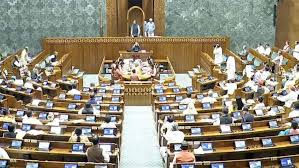
Parliament Working Days & Weekend Sittings:
Context
Discussion on holding weekend sittings to compensate lost time.
-
- The Constitution does not fix minimum number of sitting days, making parliamentary functioning flexible and rule-based.
- Sessions are conducted based on Rules of Procedure and decisions of the government, showing executive influence.
- The Business Advisory Committee (BAC) allocates time for discussion of bills and other business in Parliament.
- Frequent disruptions have led to a decline in effective legislative productivity, raising governance concerns.
- Weekend sittings are proposed to ensure completion of legislative business, including budget discussions.
- Over time, the number of working days of Parliament has decreased, compared to earlier decades.
- This affects deliberative democracy, as fewer discussions reduce scrutiny of laws.
- It reflects the growing dominance of the executive over legislature.
- Parliamentary reforms often focus on improving efficiency, accountability, and debate quality.
(TH)
Economy
Government Borrowing Programme FY26:
Context
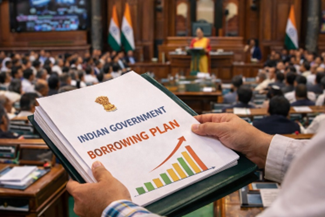
Government announced borrowing strategy. Gross Market Borrowings in BE 2026-27 was ₹17.20 lakh crore.
-
- Government borrowing is primarily done through Government Securities (G-Secs), which are tradable debt instruments used to finance fiscal deficit.
- The announcement of ₹8.2 trillion borrowing in the first half indicates a front-loading strategy, meaning funds are raised earlier to manage expenditure efficiently.
- A higher share of 10-year bonds helps create a stable benchmark yield, which is important for pricing other financial instruments in the economy.
- Reduction in ultra-long-term bonds reflects limited investor appetite for long-duration securities due to interest rate uncertainty.
- Inclusion of green bonds indicates a policy shift towards financing environmentally sustainable infrastructure projects.
- Borrowing is coordinated between the Ministry of Finance and RBI, where RBI acts as the government’s debt manager.
- High government borrowing can lead to crowding out of private investment, as it pushes up interest rates in the market.
- It directly impacts bond yields, which influence lending rates across the economy.
- Persistent high borrowing increases public debt and fiscal deficit, raising concerns about macroeconomic stability.
- It is closely monitored by rating agencies and global investors, affecting India’s creditworthiness.
(ET+PIB)
Fertilizer Supply Management:
Context
Government ensured adequate fertilizer availability. Current Stocks Stand at 53.08 LMT of Urea, 21.80 LMT of DAP, 7.98 LMT of MOP, and 48.38 LMT of NPKS
-
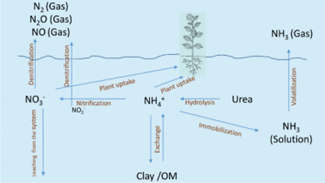
- Major fertilizers include Urea (Nitrogen), DAP (Phosphorus), and MOP (Potassium), essential for balanced plant nutrition.
- Urea is fully subsidized and price-controlled, making it cheaper and widely used by farmers.
- Other fertilizers fall under the Nutrient-Based Subsidy (NBS) scheme, where subsidy depends on nutrient content.
- India is heavily dependent on imports for potash and phosphatic fertilizers, making it vulnerable to global price fluctuations.
- Fertilizer subsidies constitute a significant portion of government expenditure in agriculture.
- Ensuring timely supply is critical for food security and agricultural productivity.
- Overuse of urea leads to soil degradation and nutrient imbalance, affecting long-term sustainability.
- Fertilizer use was a key factor in the success of the Green Revolution.
(PIB)
Fuel Excise Duty Adjustment:
Context
Government reduced excise duty, but retail fuel prices remained unchanged.
-
- Excise duty is a central indirect tax levied on manufacture of goods, including petroleum products, and forms a significant part of government revenue.
- Petroleum products are kept outside the GST regime, allowing the Centre and States to independently impose taxes and maintain fiscal flexibility.
- Even if excise duty is reduced, retail prices may not fall if oil marketing companies use the benefit to recover past losses or stabilize balance sheets.
- Fuel prices in India are linked to global crude oil prices under a dynamic pricing system, though some administrative control still exists.
- Excise duty is often used as a counter-cyclical fiscal tool, where taxes are increased during low oil prices and reduced during high prices.
- Changes in fuel prices have a cascading effect on inflation, as transport costs influence prices of most goods and services.
- Higher excise duties increase government revenue, but may also contribute to inflationary pressures in the economy.
(ET)
Geography, Mapping, Ecology & Environment and DM
Iron Ore Imports Rising:
Context
India’s iron ore imports are expected to rise.
-
- Although India has abundant iron ore reserves, a large portion is low-grade ore with high impurities, making it less efficient for steel production.
- Steel manufacturing requires high-grade ore with higher iron content, leading to imports from countries like Brazil and Australia.
- This creates a paradox where India exports low-grade ore while importing high-grade ore, highlighting issues of resource quality.
- Rising imports indicate increasing domestic demand for steel, driven by infrastructure and construction activities.
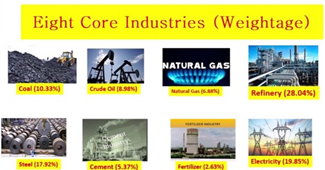
- The steel sector is classified as a core industry, and its growth has multiplier effects on the overall economy.
-
- Increased imports contribute to trade deficit and current account deficit, affecting external sector stability.
- This reflects the importance of beneficiation technology, which can upgrade low-grade ore for domestic use.
- The trend is aligned with targets under the National Steel Policy, which aims to increase steel production capacity.
- It highlights that resource availability does not guarantee self-sufficiency, unless supported by technology.
(ET)
Energy Security Assurance:
Context
Government assured availability of coal, oil, and fertilizers.
-
- Energy security refers to uninterrupted availability of energy sources at affordable prices, which is essential for economic stability.
- India maintains Strategic Petroleum Reserves (SPR) to cushion against global supply disruptions and geopolitical shocks.
- Coal remains the dominant energy source, contributing around 50% of electricity generation, despite increasing renewable capacity.
- Fertilizer production is energy-intensive, especially nitrogen-based fertilizers that depend on natural gas.
- Global geopolitical tensions, particularly in West Asia, can disrupt energy supply chains and increase prices.
- Diversification into renewable energy (solar, wind) and nuclear power is key for long-term energy security.
- Strategic reserves help in price stabilization and emergency supply management.
- India is an associate member of the International Energy Agency (IEA), not a full member.
(PIB+TH)
History, Art & Culture
Madhavpur Mela:
Context
Festival celebrated highlighting cultural unity.
-
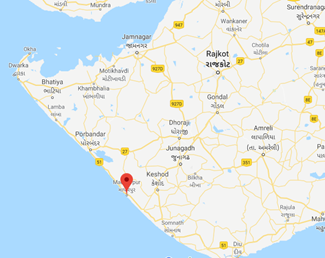
- The festival is held in Madhavpur village in Porbandar district of Gujarat, located along the Arabian Sea, giving it both cultural and geographical significance.
-
- It commemorates the marriage of Lord Krishna (Dwarka, Gujarat) and Rukmini (associated with Vidarbha and Northeast traditions), symbolizing inter-regional cultural links.
- The festival represents ancient cultural connectivity between Western India and Northeast India, a theme increasingly emphasized in national integration policies.
- It is promoted under the Ek Bharat Shreshtha Bharat initiative, which aims to strengthen emotional integration among different states of India.
- The festival is rooted in Bhagavata Purana traditions, making it an important example of Vaishnavite religious practices.
- It includes folk dances, rituals, and storytelling traditions, preserving intangible cultural heritage.
- The celebration reflects how mythology influences present-day cultural practices.
- It highlights the pan-Indian nature of Krishna worship, which transcends regional boundaries.
- Supported by the Ministry of Culture, it also acts as a tool for promoting tourism and local economy.


(IE)
Spread the Word
The post Prelims Mantra – (30/03/2026) appeared first on Lukmaan IAS.