Prelims Mantra (Practice Questions) (27/02/2026)
Quiz-summary
0 of 5 questions completed
Questions:
- 1
- 2
- 3
- 4
- 5
Information
Prelims Mantra (Practice Questions) (27/02/2026)
You have already completed the quiz before. Hence you can not start it again.
Quiz is loading…
You must sign in or sign up to start the quiz.
You have to finish following quiz, to start this quiz:
Results
0 of 5 questions answered correctly
Your time:
Time has elapsed
You have reached 0 of 0 points, (0)
Categories
-
Not categorized
0%
- 1
- 2
- 3
- 4
- 5
-
Answered -
Review
-
Question 1 of 5
1. Question
With reference to India–Israel bilateral relations, consider the following:
1. India recognized Israel in 1992.
2. India and Israel have a “Special Strategic Partnership.”
3. The strategic partnership includes cooperation in defence and technology.
Which of the statements given above are correct?
CorrectAnswer: B
Explanation:
-
- Statement 1 is incorrect: India officially recognized the State of Israel on September 17, 1950. While full diplomatic relations (the opening of regular embassies) were established only in 1992, the act of recognition occurred more than 40 years earlier.
- Statement 2 is correct: During Prime Minister Narendra Modi’s state visit to Israel on February 26, 2026, the two countries officially decided to elevate their relationship to a “Special Strategic Partnership for Peace, Innovation & Prosperity”.
- Statement 3 is correct: The strategic partnership deeply integrates cooperation in both defence and technology. Recent agreements include joint development and production of military hardware, as well as collaboration in emerging technologies such as Artificial Intelligence (AI), cybersecurity, semiconductors, and quantum computing.
IncorrectAnswer: B
Explanation:
-
- Statement 1 is incorrect: India officially recognized the State of Israel on September 17, 1950. While full diplomatic relations (the opening of regular embassies) were established only in 1992, the act of recognition occurred more than 40 years earlier.
- Statement 2 is correct: During Prime Minister Narendra Modi’s state visit to Israel on February 26, 2026, the two countries officially decided to elevate their relationship to a “Special Strategic Partnership for Peace, Innovation & Prosperity”.
- Statement 3 is correct: The strategic partnership deeply integrates cooperation in both defence and technology. Recent agreements include joint development and production of military hardware, as well as collaboration in emerging technologies such as Artificial Intelligence (AI), cybersecurity, semiconductors, and quantum computing.
-
-
Question 2 of 5
2. Question
Programmable CBDC (Central Bank Digital Currency) implies:
CorrectAnswer: B
Explanation:
Programmable CBDC (Central Bank Digital Currency) implies a currency that can be programmed to be used only under specific conditions.
While traditional money is “neutral,” programmable CBDC allows central banks or users to embed specific rules or logic directly into the digital currency itself. Key features of this programmability include:
-
- Purpose-bound usage: The currency can be restricted to specific categories, such as being usable only for fuel, groceries, or education.
- Time validity: It can be programmed with an expiry date, forcing it to be spent within a certain timeframe.
- Geofencing: Spending can be limited to certain geographic locations, such as a specific store or a school campus.
- Leakage prevention: In India, the RBI has used this to ensure that government subsidies (like those for fertilizers or foodgrains) are spent only at authorized outlets, reducing fund diversion.
IncorrectAnswer: B
Explanation:
Programmable CBDC (Central Bank Digital Currency) implies a currency that can be programmed to be used only under specific conditions.
While traditional money is “neutral,” programmable CBDC allows central banks or users to embed specific rules or logic directly into the digital currency itself. Key features of this programmability include:
-
- Purpose-bound usage: The currency can be restricted to specific categories, such as being usable only for fuel, groceries, or education.
- Time validity: It can be programmed with an expiry date, forcing it to be spent within a certain timeframe.
- Geofencing: Spending can be limited to certain geographic locations, such as a specific store or a school campus.
- Leakage prevention: In India, the RBI has used this to ensure that government subsidies (like those for fertilizers or foodgrains) are spent only at authorized outlets, reducing fund diversion.
-
-
Question 3 of 5
3. Question
India’s bilateral environment cooperation with neighbouring countries helps in:
CorrectAnswer: A
Explanation:
India’s bilateral environment cooperation with neighbouring countries helps in managing transboundary ecosystems.
This cooperation is a key element of India’s “Neighbourhood First” policy and focuses on shared ecological challenges that do not adhere to political borders.
Key Aspects of Environmental Cooperation:
-
- Transboundary conservation: India recently signed a Memorandum of Understanding (MoU) with Nepal (February 2026) specifically to manage shared ecosystems and restore wildlife corridors for species like tigers, elephants, and rhinos.
- Climate resilience: Collaborative efforts with Bhutan and Bangladesh focus on climate change mitigation, flood forecasting, and sustainable management of transboundary river basins.
- Airshed management: India has advocated for regional cooperation with Pakistan and Bangladesh to address air pollution as a shared transboundary issue within the Indo-Gangetic plain.
- Resource protection: Bilateral agreements facilitate the exchange of technical expertise to combat wildlife crime and protect natural resources like forests and water across borders.
IncorrectAnswer: A
Explanation:
India’s bilateral environment cooperation with neighbouring countries helps in managing transboundary ecosystems.
This cooperation is a key element of India’s “Neighbourhood First” policy and focuses on shared ecological challenges that do not adhere to political borders.
Key Aspects of Environmental Cooperation:
-
- Transboundary conservation: India recently signed a Memorandum of Understanding (MoU) with Nepal (February 2026) specifically to manage shared ecosystems and restore wildlife corridors for species like tigers, elephants, and rhinos.
- Climate resilience: Collaborative efforts with Bhutan and Bangladesh focus on climate change mitigation, flood forecasting, and sustainable management of transboundary river basins.
- Airshed management: India has advocated for regional cooperation with Pakistan and Bangladesh to address air pollution as a shared transboundary issue within the Indo-Gangetic plain.
- Resource protection: Bilateral agreements facilitate the exchange of technical expertise to combat wildlife crime and protect natural resources like forests and water across borders.
-
-
Question 4 of 5
4. Question
The SWIFT 2.0 platform launched by CBIC is aimed at:
CorrectAnswer: C
Explanation:
The SWIFT 2.0 platform launched by the Central Board of Indirect Taxes and Customs (CBIC) is aimed at streamlining customs and trade processes.
Launched officially on February 26, 2026, SWIFT 2.0 (Single Window Interface for Facilitating Trade) is a next-generation digital platform designed to enhance the “Ease of Doing Business” in India.
Key features of SWIFT 2.0:
-
- Unified interface: It integrates 63 Partner Government Agencies (PGAs) including FSSAI, AQCS, and PQMS into a single digital touchpoint for importers and exporters.
- Integrated declaration: Traders can submit all required regulatory data and documents once through a single application, eliminating the need to visit multiple agency portals.
- Digital NOC lifecycle: The platform enables the end-to-end digital processing of No Objection Certificates (NOCs), online payment of fees, and real-time tracking via a unified dashboard.
- Reduced dwell time: By automating inter-agency coordination and inspections, the system significantly speeds up international cargo clearances and reduces procedural delays at ports and airports.
IncorrectAnswer: C
Explanation:
The SWIFT 2.0 platform launched by the Central Board of Indirect Taxes and Customs (CBIC) is aimed at streamlining customs and trade processes.
Launched officially on February 26, 2026, SWIFT 2.0 (Single Window Interface for Facilitating Trade) is a next-generation digital platform designed to enhance the “Ease of Doing Business” in India.
Key features of SWIFT 2.0:
-
- Unified interface: It integrates 63 Partner Government Agencies (PGAs) including FSSAI, AQCS, and PQMS into a single digital touchpoint for importers and exporters.
- Integrated declaration: Traders can submit all required regulatory data and documents once through a single application, eliminating the need to visit multiple agency portals.
- Digital NOC lifecycle: The platform enables the end-to-end digital processing of No Objection Certificates (NOCs), online payment of fees, and real-time tracking via a unified dashboard.
- Reduced dwell time: By automating inter-agency coordination and inspections, the system significantly speeds up international cargo clearances and reduces procedural delays at ports and airports.
-
-
Question 5 of 5
5. Question
El Nino generally leads to:
CorrectAnswer: D
Explanation:
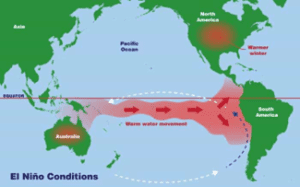
El Nino is a climate pattern characterized by the unusual warming of surface waters in the central and eastern tropical Pacific Ocean. This phenomenon disrupts global atmospheric circulation and typically has the following effects on the Indian subcontinent:
-
- Weakened monsoons: The warming in the Pacific shifts the trade winds, which weakens the moisture-laden winds coming from the Indian Ocean, often leading to drought or deficit rainfall.
- High correlation: Historically, about 60% of El Nino years have resulted in droughts or “below-normal” rainfall in India.
- Warmer winters: It often causes higher-than-average temperatures in India during the post-monsoon and winter months.
IncorrectAnswer: D
Explanation:
El Nino is a climate pattern characterized by the unusual warming of surface waters in the central and eastern tropical Pacific Ocean. This phenomenon disrupts global atmospheric circulation and typically has the following effects on the Indian subcontinent:
-
- Weakened monsoons: The warming in the Pacific shifts the trade winds, which weakens the moisture-laden winds coming from the Indian Ocean, often leading to drought or deficit rainfall.
- High correlation: Historically, about 60% of El Nino years have resulted in droughts or “below-normal” rainfall in India.
- Warmer winters: It often causes higher-than-average temperatures in India during the post-monsoon and winter months.
-
Spread the Word
The post Prelims Mantra (Practice Questions) (27/02/2026) appeared first on Lukmaan IAS.