Tracing the constitutional evolution from the Regulating Act of 1773 to the Government of India Act of 1935 reveals the gradual transition of the East India Company from a commercial body to a territorial power, and eventually to the direct rule of the British Crown.
| Act / Reform | Key Administrative Changes | Legislative & Political Shifts | Historical Significance |
|---|---|---|---|
| Regulating Act 1773 | Created Governor-General of Bengal; established Supreme Courtat Calcutta (1774). | Subordinated Bombay and Madras presidencies to Bengal. | First step of British Parliamentary control over the EIC. |
| Pitt’s India Act 1784 | Distinguished between Commercialand Political functions. | Created the Board of Control(Political) and Court of Directors(Commercial). | Established the system of “Double Government.” |
| Charter Act 1813 | Ended EIC’s trade monopoly (except tea/China); allotted ₹1 Lakh for education. | Allowed Christian missionaries to enter India for proselytization. | Asserted the sovereignty of the British Crown over India. |
| Charter Act 1833 | Designated Governor-General of India (Lord William Bentinck); centralized power. | Added a Law Member (Macaulay) to the GG’s Council. | Final step toward centralization; ended EIC’s commercial status. |
| Charter Act 1853 | Introduced Open Competition for Civil Services (Macaulay Committee). | Separated Legislative and Executive functions for the first time. | Created a “Mini-Parliament” (Legislative Council). |
| GoI Act 1858 | Transferred power to the British Crown; created Secretary of State(SoS). | Replaced Governor-General with Viceroy (Lord Canning). | Abolished the “Double Government” of 1784. |
| Indian Councils Act 1861 | Recognized the Portfolio System; restored legislative powers to Bombay/Madras. | Initiated the association of Indians with the law-making process. | Beginning of representative institutionsand decentralization. |
| Indian Councils Act 1892 | Expanded functions of Legislative Councils (Budget discussion permitted). | Introduced the elective principle(indirectly) through nominations. | Increased Indian participation in the administration. |
| Morley-Minto Reforms 1909 | Satyendra Prasad Sinha became the first Indian in the Viceroy’s Council. | Introduced Separate Electorates for Muslims. | Known for Legalizing Communalism in India. |
| Montagu-Chelmsford Reforms 1919 | Divided subjects into Reserved and Transferred (Dyarchy) at the Province level. | Introduced Bicameralism(Upper/Lower House) and Direct Elections at the Centre. | First time “Responsible Government” was an official goal. |
| GoI Act 1935 | Established Provincial Autonomy; created Federal Court (1937) and RBI (1935). | Abolished Dyarchy in Provinces; introduced Dyarchy at the Centre. | Served as the primary blueprint for the 1950 Constitution. |
Key Comparative Themes
-
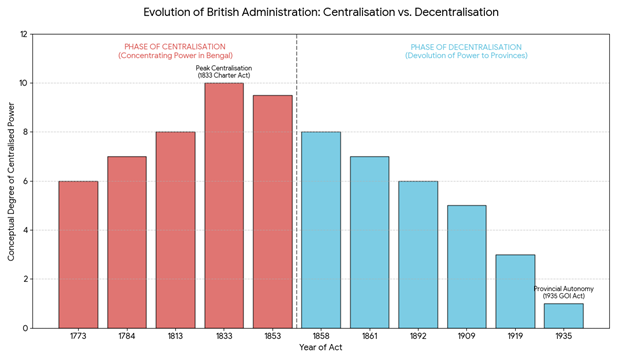
- Centralization vs. Decentralization: The process peaked in 1833 (Total Centralization) and began reversing in 1861, eventually leading to Provincial Autonomy in 1935.
- Representation: Started with nomination (1861), moved to indirect election (1892), then to separate electorates (1909), and finally reached limited adult franchise (1935).
- The Crown’s Shadow: Post-1858, the Secretary of State (based in London) became the ultimate authority, with the Viceroy acting as his agent on the ground.
British Administrative Acts (1773 – 1935)
The bars represent the degree of power concentrated at the central level (Governor-General/Viceroy) versus the power devolved to the provinces:
1. Centralisation(1773 to 1853):Power moved from the provinces (Bombay and Madras) to Bengal.
-
- Peak (1833):The Charter Act of 1833 made the Governor-General of Bengal the Governor-General of India, concentrating all legislative authority in a single person.
2. Decentralisation (1858 to 1935):
-
- Power gradually moved back from the central government to provincial governments.
- Turning Point (1861):The process began with the restoration of legislative powers to Bombay and Madras.
- Final Point (1935):The Government of India Act 1935 established Provincial Autonomy, giving provinces their own distinct legal identity and authority.
Spread the Word
The post THE HISTORICAL EVOLUTION OF INDIAN POLITY (Day-1) appeared first on Lukmaan IAS.